Why Thinking Is Becoming a Competitive Advantage
Artificial intelligence has made many forms of knowledge work dramatically easier. In seconds, AI can draft emails, summarize reports, brainstorm ideas, write code, analyze data, and generate polished presentations. These capabilities have understandably led many people to ask whether AI will replace human expertise.
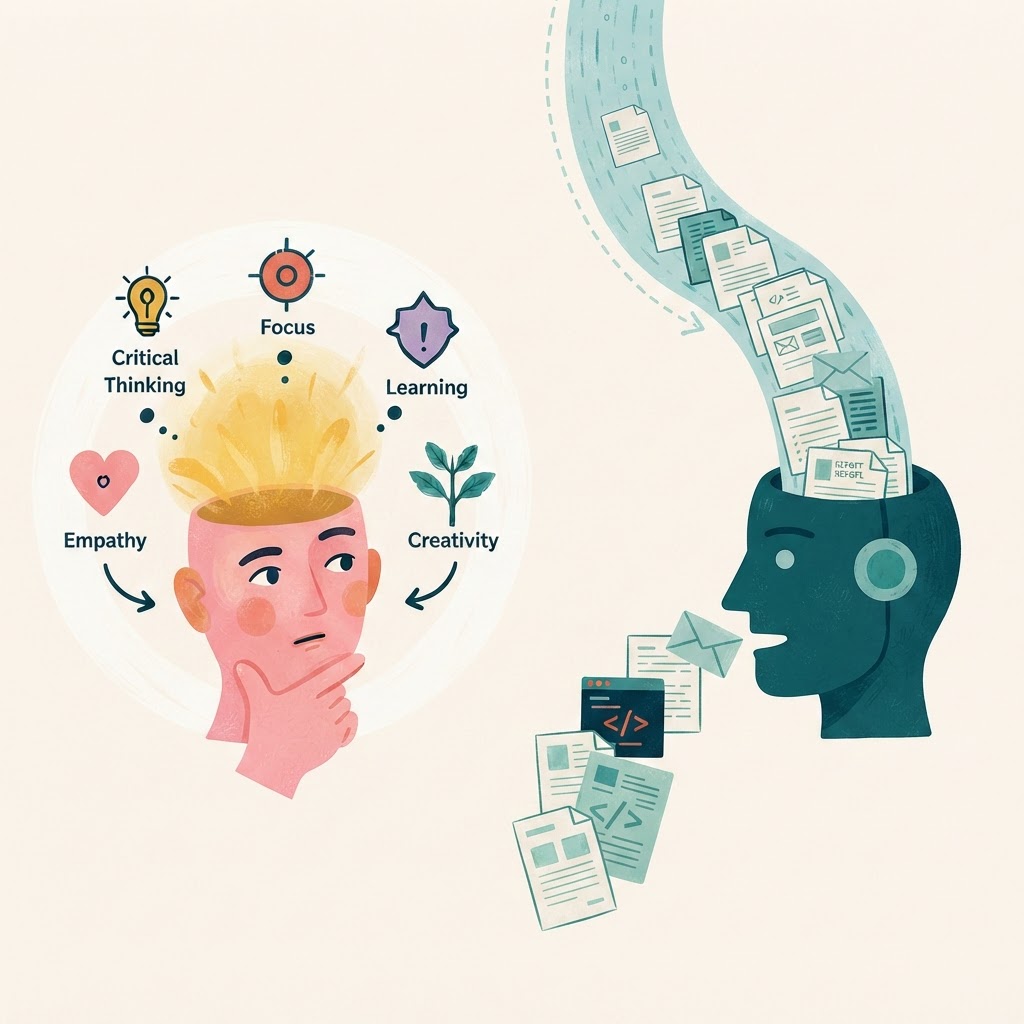
In an age where everyone has access to AI, the quality of your thinking matters more than the speed of your output.
Artificial intelligence has made many forms of knowledge work dramatically easier. In seconds, AI can draft emails, summarize reports, brainstorm ideas, write code, analyze data, and generate polished presentations. These capabilities have understandably led many people to ask whether AI will replace human expertise. A more useful question, however, may be this:
What becomes more valuable when everyone has access to the same powerful tools?
The answer is thinking.
When information is abundant and generation is inexpensive, competitive advantage shifts away from simply producing content and toward asking better questions, making sound judgments, solving novel problems, and connecting ideas in meaningful ways. AI can accelerate many tasks, but it cannot replace the uniquely human responsibility of deciding what matters, evaluating evidence, defining goals, or exercising wisdom. In fact, as AI becomes more capable, these distinctly human abilities become even more valuable.
From Information Advantage to Thinking Advantage
For much of modern history, expertise depended on access to information. Libraries, academic journals, specialist training, and years of accumulated experience created significant knowledge advantages. Today, much of that information is available within seconds through search engines and increasingly through AI assistants.
This democratization of knowledge is an extraordinary opportunity. It lowers barriers to learning and enables more people to participate in creative and intellectual work. Yet it also changes the nature of expertise. When nearly everyone has access to similar information, success depends less on possessing facts and more on interpreting them effectively.
Psychologist Daniel Kahneman observed that good judgment requires more than intelligence; it requires awareness of how our thinking can be influenced by biases, heuristics, and overconfidence.1 AI does not eliminate these challenges. If anything, it can amplify them by presenting plausible but incorrect answers with remarkable confidence. Users who accept AI-generated responses uncritically may make faster decisions, but not necessarily better ones.
In this environment, the ability to think critically becomes a competitive advantage that technology cannot easily replicate.
The Hidden Risk of Convenience
One of AI's greatest strengths is reducing cognitive effort. It can organize information, generate alternatives, explain concepts, and automate repetitive work. Used thoughtfully, these capabilities free us to focus on higher-value thinking.
However, convenience has a trade-off.
Researchers describe cognitive offloading as the practice of relying on external tools to reduce mental effort.2 We all do this. Calendars help us remember appointments. Calculators reduce arithmetic errors. GPS helps us navigate unfamiliar cities. These tools allow us to conserve mental resources for more demanding tasks.
The concern arises when AI begins performing the very thinking that helps us develop expertise. If we routinely ask AI to generate arguments we could formulate ourselves, summarize material we have never read, or make decisions without careful evaluation, we miss opportunities to strengthen the cognitive abilities that underlie creativity, judgment, and learning.
Just as muscles become stronger through use, many aspects of thinking improve through deliberate mental effort. Learning scientists refer to this principle as "desirable difficulties"—the idea that appropriately challenging learning experiences often produce deeper and more durable understanding than effortless ones.3
The goal, therefore, is not to avoid AI. It is to use AI in ways that preserve and strengthen our capacity to think.
Thinking Is a Skill, Not a Trait
Many people assume that good thinkers are simply born with exceptional intelligence. Research suggests otherwise.
Expert performance develops through deliberate practice, reflection, feedback, and the gradual refinement of mental models over time.4 Skilled professionals are not merely faster at solving problems. They often perceive problems differently because they have developed richer conceptual frameworks and more effective ways of organizing knowledge.5
This distinction matters because it means thinking can be improved.
The quality of your questions can improve. Your ability to evaluate evidence can improve. Your capacity to recognize assumptions, consider multiple perspectives, and reflect on your own reasoning can all improve with intentional practice.
AI can support this process when it is used as a thinking partner rather than a substitute for thinking. Instead of asking AI to complete your work, you might ask it to challenge your assumptions, identify weaknesses in your reasoning, generate alternative perspectives, or quiz you on a concept before explaining it. These interactions require active engagement and help transform AI from an answer machine into a learning partner.
Building Cognitive Fitness
Physical fitness is rarely achieved through occasional bursts of intense exercise. It develops through consistent habits practiced over time.
The same principle applies to thinking.
Every time you explain an idea in your own words, retrieve information from memory, reflect on a decision, evaluate competing arguments, or wrestle with a difficult question, you are strengthening the mental processes that support future learning and reasoning. Educational psychologists have repeatedly shown that active learning strategies outperform passive review for long-term retention and understanding.6
This ongoing process of strengthening the mind can be thought of as cognitive fitness. Like physical fitness, it is not a destination but a lifelong practice. The habits you cultivate today influence the quality of your thinking tomorrow.
In an AI-enabled world, cognitive fitness may become one of the most valuable professional assets you can develop. Technical tools will continue to evolve rapidly, but the ability to think clearly, adapt to new situations, and make sound decisions will remain essential regardless of how technology changes.
Beyond What AI Can Do
Most conversations about AI begin with its capabilities: how quickly it can write, analyse, summarise, or generate ideas. Those capabilities matter, but they are only part of the story.
The more enduring impact of AI will come from the habits it reinforces in the people who use it. Some will use it to challenge assumptions, explore unfamiliar perspectives, and sharpen their reasoning. Others will gradually outsource the very cognitive work that develops judgment, creativity, and expertise.
The technology itself does not determine which path we take. Our patterns of use do.
As AI becomes woven into everyday work, technical access will matter less than cognitive advantage. The people who stand out will not simply be those who produce more. They will be those who think more clearly, ask more insightful questions, exercise sound judgment, and use AI to extend—not replace—their own intelligence.
Try This
The next time you use AI, resist the urge to ask for an immediate answer.
Instead, begin with one of these prompts:
- Before answering, ask me five questions that will improve my thinking about this problem.
- Challenge my assumptions and identify anything I may be overlooking.
- Help me reason through this step by step instead of solving it for me.
Notice how the conversation changes when AI helps you think rather than simply produces an answer.
Key Takeaways
- As AI makes information and content generation more accessible, high-quality thinking becomes increasingly valuable.
- Critical thinking, judgment, creativity, and reflection are durable human capabilities that complement AI rather than compete with it.
- Cognitive offloading can be beneficial, but relying on AI to perform higher-order thinking may reduce opportunities for learning.
- Thinking is a skill that can be strengthened through deliberate practice and intentional habits.
- The most effective use of AI is as a thinking partner that challenges and develops your mind.
Continue the Conversation
The AI Thinking Partner Playbook introduces seven practical frameworks for using AI to strengthen—not replace—your thinking. If you want to build better questions, make better decisions, and develop lasting cognitive fitness, download your free copy and begin training your mind.
References
-
Kahneman, D. Thinking, Fast and Slow. London: Penguin Books (2011).
-
Risko, E.F. & Gilbert, S.J. Cognitive offloading. Trends in Cognitive Sciences 20, 676–688 (2016).
-
Bjork, R.A. & Bjork, E.L. Making things hard on yourself, but in a good way: Creating desirable difficulties to enhance learning. In: Gernsbacher, M.A., Pew, R.W., Hough, L.M. & Pomerantz, J.R. (eds.) Psychology and the Real World: Essays Illustrating Fundamental Contributions to Society. Worth Publishers, 56–64 (2011).
-
Ericsson, K.A., Krampe, R.T. & Tesch-Römer, C. The role of deliberate practice in the acquisition of expert performance. Psychological Review 100, 363–406 (1993).
-
Chi, M.T.H., Feltovich, P.J. & Glaser, R. Categorization and representation of physics problems by experts and novices. Cognitive Science 5, 121–152 (1981).
-
Freeman, S. et al. Active learning increases student performance in science, engineering, and mathematics. Proceedings of the National Academy of Sciences 111, 8410–8415 (2014).
Enjoying this article?
Get more like it delivered to your inbox once a month.