Better Meetings Through Better Questions
Think about the last meeting you attended. Perhaps it was a weekly team update, a project planning session, or a strategic discussion. The agenda was clear, people contributed ideas, and decisions were made. Yet as the meeting ended, you were left wondering whether the group had actually explored the most important issues. Were assumptions challenged? Were alternative perspectives considered? Did everyone leave with greater clarity, or had the conversation simply reinforced what people already believed?
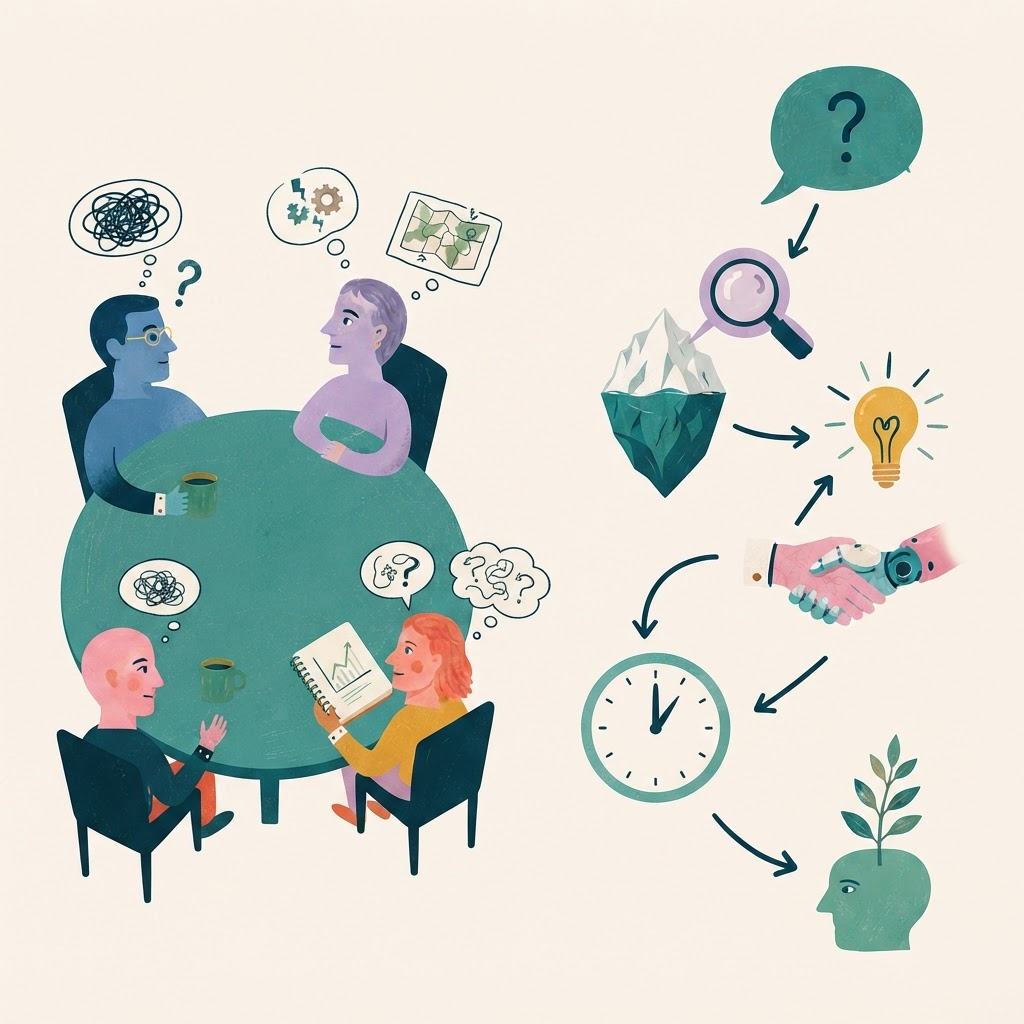
Most meetings don't suffer from a lack of answers. They suffer from a lack of thoughtful questions.
Think about the last meeting you attended. Perhaps it was a weekly team update, a project planning session, or a strategic discussion. The agenda was clear, people contributed ideas, and decisions were made. Yet as the meeting ended, you were left wondering whether the group had actually explored the most important issues. Were assumptions challenged? Were alternative perspectives considered? Did everyone leave with greater clarity, or had the conversation simply reinforced what people already believed?
Meetings occupy an enormous proportion of modern work. Managers often spend more than half of their working week in meetings, while knowledge workers devote significant portions of their day to discussions intended to coordinate projects, solve problems, and make decisions.1 Despite this investment of time, many meetings produce surprisingly little insight because they focus on generating answers before asking sufficiently good questions.
The quality of a conversation is shaped by the quality of the questions that guide it. Better questions broaden thinking, reveal hidden assumptions, uncover risks, and encourage deeper collaboration. In an era where AI can generate answers almost instantly, learning to ask thoughtful questions is becoming one of the most valuable contributions anyone can make in a meeting.
Questions Shape How Groups Think
Questions do more than request information. They influence the direction of attention, determine which ideas receive consideration, and establish the boundaries of the discussion.
Imagine a product team debating declining customer engagement. If the conversation begins with, "How can we increase usage?", the discussion will naturally focus on features, marketing campaigns, and customer incentives. If instead someone asks, "Why might customers no longer find this product valuable?", the conversation shifts towards customer needs, changing expectations, and the possibility that the underlying problem has been misunderstood.
Neither question is inherently better than the other, but they produce very different conversations. The first assumes the product remains valuable and seeks ways to encourage greater use. The second invites the group to reconsider that assumption altogether. A well-chosen question can therefore change not only the discussion but the decisions that emerge from it.
Research into organisational learning suggests that effective teams spend more time exploring problems before rushing towards solutions.2 By framing discussions around thoughtful questions, they create space for curiosity, reflection, and critical thinking rather than immediate consensus.
Curiosity Is More Valuable Than Certainty
Many meetings unintentionally reward confidence over curiosity. Participants often feel pressure to contribute answers quickly because expertise is associated with having solutions rather than asking questions. As a result, discussions can become competitions between opinions instead of collaborative investigations.
The strongest teams operate differently. They recognise that complex problems rarely have obvious answers and that genuine understanding develops through exploration. Rather than treating questions as signs of uncertainty or weakness, they use them to uncover assumptions, clarify objectives, and identify information that may be missing.
Research by organisational psychologist Amy Edmondson has shown that teams perform better when psychological safety allows people to ask questions, acknowledge uncertainty, and admit they do not yet know the answer.3 When curiosity becomes part of a team's culture, conversations become more open, more rigorous, and ultimately more productive.
The Questions That Improve Every Meeting
Not every question contributes equally to better thinking. Some simply request information, while others encourage people to examine the problem from new perspectives. Consider incorporating questions such as:
- What assumptions are we making?
- What evidence supports this conclusion?
- What evidence might challenge it?
- Whose perspective is missing from this discussion?
- What problem are we actually trying to solve?
- If we started again today, would we make the same decision?
- What risks have we overlooked?
- What would success look like one year from now?
Questions like these encourage groups to pause before committing to a particular course of action. They shift attention away from defending existing opinions and towards collectively exploring the quality of the team's reasoning. Importantly, these questions do not slow decision-making unnecessarily. They reduce the likelihood of costly mistakes by ensuring that decisions are built on stronger foundations.
Avoiding Groupthink
One of the greatest risks in collaborative decision-making is groupthink, a phenomenon in which the desire for agreement discourages people from expressing disagreement or considering alternative viewpoints.4 Teams affected by groupthink often appear highly aligned, yet their decisions may overlook significant risks because dissenting voices remain silent.
Effective questions help prevent this dynamic. Asking, "What might we be wrong about?" or "How would someone who disagrees with us see this issue?" gives permission for alternative perspectives to emerge without framing disagreement as conflict. Leaders play an especially important role in creating these conversations. When leaders openly invite criticism of their own ideas, acknowledge uncertainty, and reward thoughtful disagreement, they signal that the goal of the meeting is better thinking rather than personal validation. This encourages a culture in which ideas are tested rather than protected.
AI Can Make Meetings More Thoughtful
Artificial intelligence has the potential to transform meetings, but not simply by taking notes or generating action items. Its greater value lies in helping teams think more deeply before, during, and after important discussions.
Before a meeting, AI can generate questions that challenge assumptions, identify blind spots, or suggest perspectives that may not otherwise be considered. During a meeting, it can help summarise competing viewpoints, identify unresolved issues, and highlight areas where evidence appears incomplete. Afterwards, it can help teams reflect on the quality of their reasoning by identifying unanswered questions, documenting assumptions, and suggesting areas for further investigation.
Rather than asking AI to decide what the team should do, use it to improve the questions guiding the conversation. A meeting that explores the right questions will almost always produce better decisions than one that simply generates more answers.
Every Meeting Is a Learning Opportunity
Many organisations evaluate meetings by asking whether decisions were made. A more useful question is whether the group left with a deeper understanding of the problem than when the meeting began. Even when a meeting concludes without a final decision, it may still represent valuable progress if participants have clarified assumptions, identified missing information, or reframed the problem more accurately. Better questions frequently improve future decisions because they reveal issues that would otherwise have remained hidden.
Teams that consistently ask thoughtful questions also become stronger learners. They review past decisions, examine unexpected outcomes, and continuously refine how they think together. Over time, this creates an organisational culture in which learning becomes a competitive advantage rather than an occasional activity.
Better Questions Build Better Teams
The most effective meetings are not defined by how many ideas are shared or how quickly decisions are reached. They are defined by whether the conversation improves the quality of collective thinking. This perspective sits at the heart of cognitive fitness. Strong teams cultivate habits of curiosity, critical thinking, and intellectual humility. They understand that thoughtful questions often create more value than immediate answers because questions reveal assumptions, encourage exploration, and strengthen decision-making.
Artificial intelligence can make meetings faster, more organised, and more efficient. The uniquely human contribution is deciding which questions deserve to be asked. As AI becomes increasingly capable of generating answers, the organisations that thrive will be those that build cultures centred on thoughtful inquiry, open discussion, and better questions.
Try This
Before your next meeting, ask AI:
I'm preparing for a meeting about [topic]. Generate ten questions that will help the team challenge assumptions, explore alternative perspectives, identify overlooked risks, clarify the real problem we're trying to solve, and improve the quality of our decision-making. Prioritise questions that encourage discussion rather than immediate agreement.
Choose two or three questions to introduce during the meeting and observe how they change the direction of the conversation.
Key Takeaways
- The quality of a meeting depends largely on the quality of the questions being asked.
- Thoughtful questions uncover assumptions, broaden perspectives, and strengthen decision-making.
- Curiosity creates better collaboration than premature certainty.
- AI is most valuable when it helps teams generate better questions rather than simply producing answers.
- Organisations that consistently ask better questions develop stronger cultures of learning and cognitive fitness.
Continue the Conversation
The AI Thinking Partner Playbook introduces seven practical frameworks for using AI to strengthen—not replace—your thinking. The Socratic Guide, Challenger, and Perspective Expander frameworks help you prepare better questions, challenge assumptions, and facilitate richer discussions that lead to stronger decisions. Download your free copy and begin building the cognitive fitness needed to lead more thoughtful conversations in the age of AI.
References
-
Rogelberg, S.G. The Surprising Science of Meetings: How You Can Lead Your Team to Peak Performance. Oxford: Oxford University Press (2019).
-
Argyris, C. Reasoning, Learning, and Action: Individual and Organizational. San Francisco: Jossey-Bass (1982).
-
Edmondson, A.C. The Fearless Organization: Creating Psychological Safety in the Workplace for Learning, Innovation, and Growth. Hoboken, NJ: Wiley (2019).
-
Janis, I.L. Groupthink: Psychological Studies of Policy Decisions and Fiascoes. 2nd edn. Boston: Houghton Mifflin (1982).
-
Kahneman, D., Sibony, O. & Sunstein, C.R. Noise: A Flaw in Human Judgment. London: William Collins (2021).
-
Schein, E.H. Humble Inquiry: The Gentle Art of Asking Instead of Telling. 2nd edn. Oakland, CA: Berrett-Koehler (2021).
-
Isaacs, W. Dialogue and the Art of Thinking Together. New York: Currency (1999).
Enjoying this article?
Get more like it delivered to your inbox once a month.