The Science of Better Questions
Artificial intelligence has made answers remarkably easy to obtain. Within seconds, we can generate explanations, summaries, recommendations, and ideas on almost any topic imaginable. As a result, many people have become better at requesting information than at directing inquiry.
The quality of your answers is often limited by the quality of your questions.
Artificial intelligence has made answers remarkably easy to obtain. Within seconds, we can generate explanations, summaries, recommendations, and ideas on almost any topic imaginable. As a result, many people have become better at requesting information than at directing inquiry.
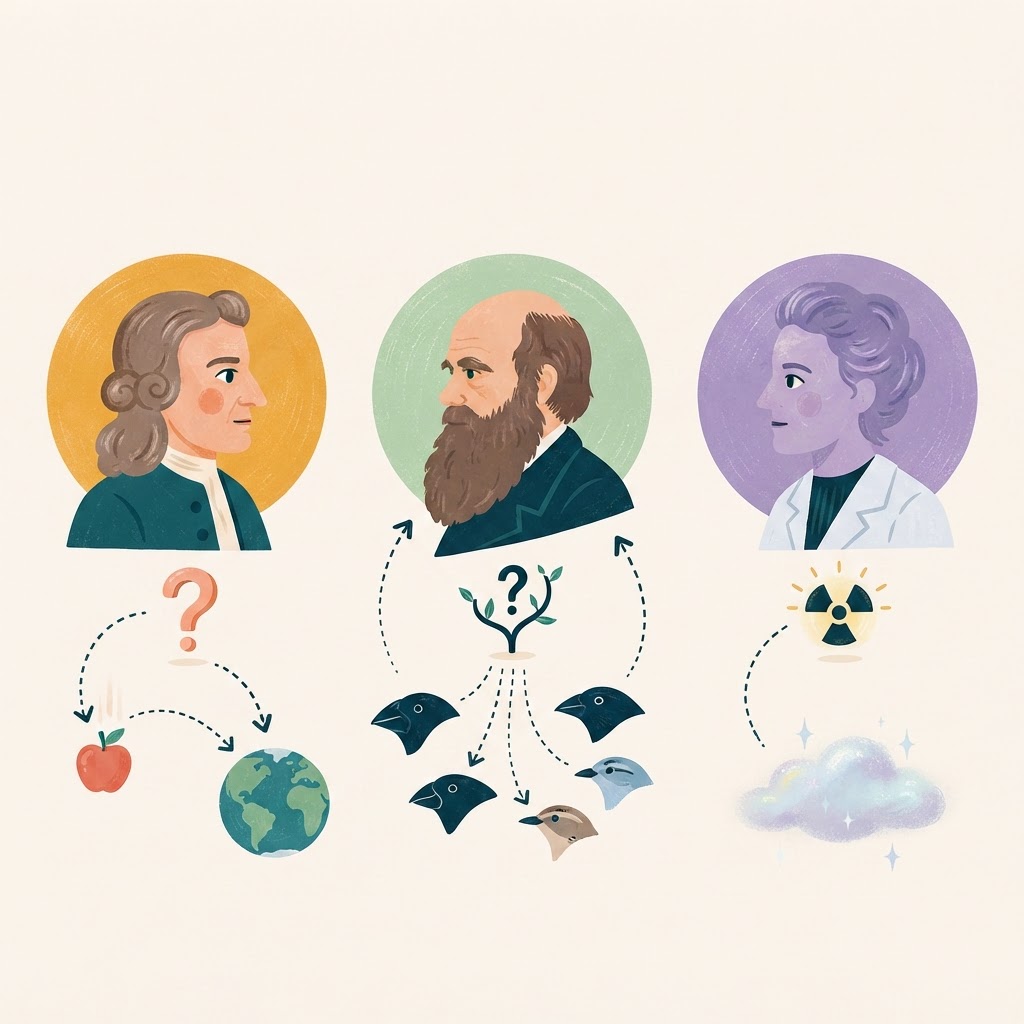
Throughout history, however, progress in science, philosophy, medicine, and innovation has rarely begun with better answers. It has begun with better questions. Isaac Newton wondered why objects fall toward the Earth. Charles Darwin questioned why species differ from one another. Marie Curie asked whether invisible forms of radiation might exist. Their discoveries were not simply products of intelligence; they were the result of asking questions that revealed something others had overlooked.
The same principle applies in everyday life. Whether we are solving problems at work, making important decisions, learning new skills, or collaborating with AI, the questions we ask shape the quality of our thinking. In an age of intelligent machines, learning to ask better questions may become one of the most valuable human capabilities we can develop.
Questions Direct Attention
One reason questions are so powerful is that they shape attention. Our brains constantly receive more information than we can consciously process, so attention acts as a filter, determining what we notice and what we overlook. Cognitive psychologists have shown that attention is a limited resource, meaning that directing it effectively is fundamental to learning and decision-making.1
Imagine walking through a forest with a friend. If they ask you to count the number of birds you see, your attention naturally shifts toward movement, colour, and birdsong. If they instead ask you to identify signs of ecological change, you begin noticing fallen trees, invasive plants, water quality, and patterns in the landscape. The forest itself has not changed. What has changed is the lens through which you are observing it.
The same principle applies when working with AI. Asking, "Write this report for me," directs attention toward producing an output as efficiently as possible. Asking, "What assumptions am I making that deserve closer examination?" directs attention toward improving judgment. Before AI generates a response, your question has already determined what kind of thinking will take place.
Learning Begins with Inquiry
Educational research consistently shows that people learn more effectively when they actively generate ideas rather than passively receive information.2 This principle, often referred to as generative learning, suggests that understanding develops through mental effort. Activities such as explaining concepts in your own words, making predictions, asking questions, and connecting new information to prior knowledge require the learner to organize ideas into meaningful mental structures.
Consider two students studying climate science. One asks, "What is the greenhouse effect?" and receives a clear explanation. The other asks, "Why did Earth's atmosphere evolve in a way that allows the greenhouse effect to sustain life, and what happens when that balance changes?" The second question encourages deeper reasoning because it explores relationships, mechanisms, and consequences rather than isolated facts.
Artificial intelligence is particularly well suited to supporting this kind of learning because it can sustain extended dialogue rather than simply delivering isolated answers. Used well, it can ask follow-up questions, adapt explanations to your current understanding, and encourage you to reason through difficult concepts instead of merely reading about them.
The Socratic Tradition
More than two thousand years ago, Socrates became famous not because he gave memorable lectures, but because he asked memorable questions. Rather than telling students what to think, he guided them through conversations that exposed contradictions, clarified assumptions, and encouraged them to examine their own reasoning. This approach remains influential because it transforms learning into an active process rather than a passive one.3
The goal of Socratic questioning is not to trap people or win arguments. It is to develop clearer thinking. Questions such as "What evidence supports this conclusion?", "What assumptions am I making?", "What alternative explanations are possible?", and "What would change my mind?" encourage intellectual humility and invite us to examine ideas more carefully before accepting them.
This is one of the most valuable ways to use AI. Instead of treating it as an answer machine, we can ask it to become a thoughtful conversation partner. AI can challenge weak reasoning, identify blind spots, propose alternative perspectives, and ask follow-up questions that encourage deeper reflection. In doing so, it extends a tradition of inquiry that has shaped education for centuries.
Why Experts Ask Different Questions
Research comparing experts with novices has revealed that expertise involves more than simply knowing more facts. Experts organize knowledge differently and often spend considerably more time understanding a problem before attempting to solve it.4 They recognize that the way a problem is defined often determines the quality of its solution.
This difference becomes apparent in the questions experts ask. A novice programmer might ask, "How do I fix this error?" An experienced software engineer is more likely to ask, "What assumptions about the system allowed this error to occur?" Similarly, a novice manager may ask, "How do I motivate my team?" whereas an experienced leader might ask, "What conditions allow motivation to emerge naturally?"
These examples illustrate an important point: changing the question often changes the solution. Many difficult problems become more manageable when they are reframed around underlying causes rather than immediate symptoms.
AI Makes Questions More Valuable, Not Less
At first glance, it might seem that AI reduces the importance of asking good questions because it can infer what we mean and generate useful responses even from vague prompts. In practice, however, AI makes thoughtful questioning even more valuable. As answers become increasingly abundant, the ability to identify worthwhile questions becomes increasingly rare.
Almost anyone can generate dozens of ideas in a matter of minutes. Fewer people can determine which ideas deserve careful consideration. Almost anyone can summarize a research paper with AI. Fewer people can ask the questions that reveal its assumptions, limitations, and practical implications. Likewise, AI can generate strategic recommendations, but only human judgment can determine whether those recommendations align with long-term goals, ethical values, and real-world constraints.
As information becomes easier to obtain, inquiry becomes a distinguishing capability. The people who benefit most from AI are unlikely to be those who produce the greatest volume of content. They will be those who use AI to investigate uncertainty, test reasoning, and deepen understanding.
Designing Better Questions
Fortunately, asking better questions is a skill that can be developed through practice. One useful strategy is to move beyond factual questions and toward reflective ones that explore reasoning, assumptions, and evaluation. Instead of asking, "What is the answer?", consider asking, "How should I think about this problem?" Instead of asking, "Which option is best?", ask, "What criteria should I use to evaluate these options?"
The same approach applies when using AI for learning. Rather than requesting a summary of an article before reading it, you might ask AI to identify several important concepts to watch for and then quiz you after you have finished reading. Instead of requesting a completed piece of writing, ask AI to critique your own draft and identify weaknesses in your reasoning. These approaches preserve the mental effort that supports learning while still benefiting from AI's capabilities.
Another effective habit is to ask follow-up questions that deepen rather than broaden the conversation. Questions such as "Why?", "Compared with what?", "Under what conditions would this not be true?", and "What evidence would change this conclusion?" often produce richer insights than immediately moving to an entirely different topic. They encourage sustained exploration instead of superficial coverage.
Better Questions Build Better Thinkers
Curiosity is often described as the desire to know, but it might be better understood as the willingness to continue asking. Strong thinkers rarely assume they have reached the final answer. Instead, they remain open to new evidence, alternative explanations, and different perspectives because they understand that learning is an ongoing process rather than a finished destination.
Artificial intelligence offers an unprecedented opportunity to practise this habit every day. Unlike traditional search engines, AI can engage in extended conversations, adapt to our level of understanding, and challenge us with increasingly sophisticated questions. Whether those conversations strengthen our thinking depends largely on how we choose to engage with the technology.
Learning to ask better questions is therefore about much more than writing effective prompts. It is about developing a habit of inquiry that improves learning, strengthens judgment, and leads to wiser decisions in every area of life.
Try This
Choose a problem you are currently working on.
Before asking AI for advice, write down five questions about the problem. Then revise each one to make it more specific, more open-ended, more focused on understanding than immediate solutions, and more likely to challenge your existing assumptions.
Finally, ask AI to answer your revised questions one at a time, encouraging dialogue rather than requesting a single final response. Pay attention to how the quality of the conversation changes when the quality of your questions improves.
Key Takeaways
- Questions direct attention and influence what we notice, learn, and remember.
- Active inquiry produces deeper learning than passive information consumption.
- Socratic questioning helps uncover assumptions and strengthen reasoning.
- Experts often solve problems more effectively because they define them more thoughtfully.
- AI becomes a more valuable thinking partner when used to explore questions rather than simply generate answers.
Continue the Conversation
The AI Thinking Partner Playbook introduces seven practical frameworks for using AI to strengthen—not replace—your thinking. One of those frameworks, The Socratic Guide, is specifically designed to help you learn through dialogue, ask better questions, and develop deeper understanding. Download your free copy and begin training your mind.
References
-
Posner, M.I. & Rothbart, M.K. Research on attention networks as a model for the integration of psychological science. Annual Review of Psychology 58, 1–23 (2007).
-
Fiorella, L. & Mayer, R.E. Learning as a Generative Activity: Eight Learning Strategies That Promote Understanding. Cambridge: Cambridge University Press (2015).
-
Paul, R. & Elder, L. The Thinker's Guide to Socratic Questioning. Foundation for Critical Thinking (2006).
-
Chi, M.T.H., Feltovich, P.J. & Glaser, R. Categorization and representation of physics problems by experts and novices. Cognitive Science 5, 121–152 (1981).
-
Roediger III, H.L. & Karpicke, J.D. Test-enhanced learning: Taking memory tests improves long-term retention. Psychological Science 17, 249–255 (2006).
-
Brown, P.C., Roediger III, H.L. & McDaniel, M.A. Make It Stick: The Science of Successful Learning. Cambridge, MA: Harvard University Press (2014).
-
Grant, A. Think Again: The Power of Knowing What You Don't Know. New York: Viking (2021).
Enjoying this article?
Get more like it delivered to your inbox once a month.