Learning Faster Through Teaching
It's easy to mistake familiarity for understanding. You read a book, watch a lecture, listen to a podcast, or ask AI to explain a complex topic. Everything makes sense while you're consuming the information. You feel confident that you've learned something valuable. Then someone asks you a simple question: *"Can you explain it?"* Suddenly, the confidence begins to fade. The explanation feels incomplete.
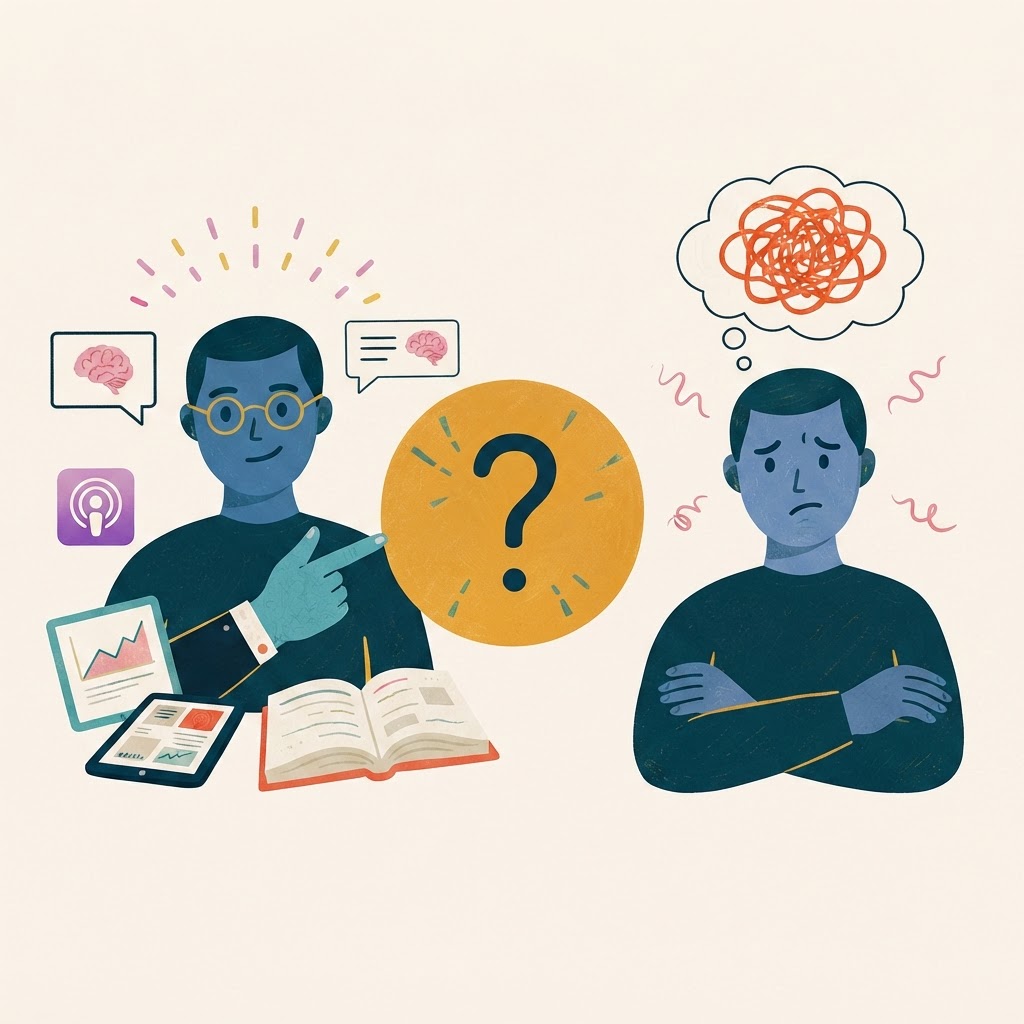
One of the fastest ways to discover whether you truly understand something is to try teaching it to someone else.
It's easy to mistake familiarity for understanding. You read a book, watch a lecture, listen to a podcast, or ask AI to explain a complex topic. Everything makes sense while you're consuming the information. You feel confident that you've learned something valuable. Then someone asks you a simple question: "Can you explain it?"
Suddenly, the confidence begins to fade. The explanation feels incomplete. Important details are missing. Ideas that seemed connected in your mind become difficult to organise into a coherent story. What felt like understanding turns out to be recognition rather than mastery.
This experience is not a weakness—it is one of the most powerful learning opportunities available. Research consistently shows that preparing to teach and explaining ideas to others strengthens learning far more effectively than simply reviewing information.1 Teaching transforms passive knowledge into active understanding, forcing us to organise ideas, identify gaps, and communicate clearly.
In the age of AI, this lesson is more important than ever. If artificial intelligence explains everything for us, we may feel informed without becoming knowledgeable. By teaching what we learn—even if our audience is simply an AI assistant—we develop the kind of deep understanding that information alone cannot provide.
Why Teaching Changes the Way We Learn
Learning often feels like a process of collecting information.
We attend lectures, read articles, complete online courses, and ask AI to summarise complex ideas. While these activities expose us to new knowledge, they do not necessarily require us to make sense of it ourselves. Teaching changes that relationship.
When we expect to explain an idea to another person, our brains begin processing information differently. Instead of merely remembering isolated facts, we organise concepts into meaningful structures, anticipate questions, identify examples, and connect new information with what we already know. Educational psychologists describe this as generative learning because learners actively construct understanding rather than passively receiving it.2 The result is learning that is richer, more flexible, and easier to recall.
The Protégé Effect
Researchers have identified an interesting phenomenon known as the protégé effect.
People who believe they will teach material later often learn it more thoroughly than people who study only for a test.3 The expectation of teaching changes how we pay attention, what we notice, and how we organise information during learning. This effect occurs because teaching creates responsibility.
If you expect someone to ask questions, you naturally begin looking for weaknesses in your own understanding. You think about how ideas fit together instead of memorising isolated facts. You search for examples that make abstract concepts easier to understand. In doing so, you strengthen your own mental models. Teaching therefore becomes an active form of retrieval practice, elaboration, and reflection all at once—three learning strategies that cognitive science consistently associates with durable understanding.4
Explaining Reveals the Gaps
One of teaching's greatest strengths is that it exposes what we don't know. Imagine trying to explain how machine learning works to a friend with no technical background. You quickly discover whether you genuinely understand concepts such as training data, pattern recognition, and prediction, or whether you have simply become familiar with the terminology. This process resembles what physicist Richard Feynman popularised as the Feynman Technique. His advice was deceptively simple: if you cannot explain a concept in clear, everyday language, you probably do not understand it well enough yourself.5
The value of this approach lies not in producing perfect explanations but in identifying uncertainty. Every moment of hesitation points towards an opportunity for deeper learning. Instead of asking, "Do I know this?", teaching encourages a more useful question: "Can I explain this clearly enough that someone else could understand it?"
Retrieval Strengthens Memory
Teaching also improves memory because it requires retrieval rather than recognition. Reading notes or highlighting text often creates the comforting feeling that learning has occurred. Unfortunately, recognition is much easier than recall. Looking at information repeatedly can create an illusion of mastery without strengthening long-term memory. Teaching reverses this process.
When we explain an idea without looking at our notes, we retrieve information from memory, organise it into a logical sequence, and adapt it for another person. Research on retrieval practice consistently demonstrates that this effort strengthens learning far more effectively than rereading material alone.6
Every explanation becomes a memory exercise. Every question from a learner becomes another opportunity to reinforce understanding. Rather than viewing these moments as tests of intelligence, we can see them as opportunities to build stronger knowledge.
AI as Your Student
Artificial intelligence creates a unique opportunity because you no longer need another person to benefit from teaching. Instead of asking AI to explain a concept, ask AI to become your student. For example, you might say:
I'm learning about systems thinking. Act as a curious student who knows nothing about the topic. Ask me questions one at a time, challenge unclear explanations, and keep asking for clarification until my explanation is simple, accurate, and complete.
This changes the entire conversation. Instead of AI performing the cognitive work, you become responsible for organising your knowledge. AI simply provides the questions that expose gaps in your understanding. The result is similar to teaching another person. You discover where your reasoning is incomplete, where your explanations become vague, and where additional learning is needed. In this role, AI becomes a catalyst for deeper understanding rather than a substitute for it.
Teaching Yourself Through Writing
Teaching does not always require an audience. Writing is one of the simplest forms of self-teaching because it forces us to explain ideas clearly enough that another person could eventually read them. Whether we are writing a journal entry, a blog post, meeting notes, or a summary of a book, the process requires us to organise, simplify, and connect ideas.
This explains why many researchers, educators, and leaders write regularly even when they have no intention of publishing their work. Writing helps transform fragmented thoughts into coherent understanding. One useful habit is to finish every book, article, or podcast by writing a short explanation in your own words.
What were the main ideas?
Why do they matter?
How do they connect with what you already know?
What questions remain unanswered?
These reflections become powerful learning tools because they encourage understanding rather than accumulation.
Learning That Lasts
Many people measure learning by how much information they consume. Strong thinkers measure learning differently. They ask whether they can explain ideas clearly, apply concepts in new situations, recognise misunderstandings, and continue improving their mental models over time.
Teaching develops all of these abilities simultaneously. It transforms learning from a passive activity into an active conversation with knowledge itself. Every explanation strengthens understanding. Every question reveals a new opportunity for growth.
This is why teaching is such an important component of cognitive fitness. It develops not only memory but also reasoning, communication, metacognition, and intellectual humility. It reminds us that genuine understanding is demonstrated not by recognising information but by making it meaningful for someone else.
Artificial intelligence gives us instant access to extraordinary knowledge. The challenge is ensuring that knowledge becomes our own. Teaching—whether to another person, through writing, or with AI acting as our student—remains one of the most effective ways to make that transformation happen.
Try This
Choose something you've learned recently. Instead of asking AI to explain it again, use this prompt:
Act as a curious beginner. I'll teach you about [topic]. Ask one question at a time. If my explanation is unclear, incomplete, or uses jargon, ask follow-up questions until I can explain the concept simply and accurately. At the end, identify the areas where my understanding is strongest and where I should learn more.
Notice how differently you engage with the material when you're responsible for the explanation instead of the AI.
Key Takeaways
- Teaching is one of the most effective ways to deepen understanding.
- Preparing to teach changes how we organise and process information.
- Explaining concepts reveals gaps that passive learning often hides.
- Retrieval during teaching strengthens long-term memory more effectively than rereading.
- AI can become a valuable learning partner by acting as your student rather than your teacher.
Continue the Conversation
The AI Thinking Partner Playbook introduces seven practical frameworks for using AI to strengthen—not replace—your thinking. The Teaching Test framework shows you how to use explanation, reflection, and AI-powered dialogue to deepen understanding and build lasting cognitive fitness. Download your free copy and start learning by teaching today.
References
-
Fiorella, L. & Mayer, R.E. Learning as a Generative Activity: Eight Learning Strategies That Promote Understanding. Cambridge: Cambridge University Press (2015).
-
Chi, M.T.H. Active-constructive-interactive: A conceptual framework for differentiating learning activities. Topics in Cognitive Science 1, 73–105 (2009).
-
Nestojko, J.F., Bui, D.C., Kornell, N. & Bjork, E.L. Expecting to teach enhances learning and organisation of knowledge in free recall of text passages. Memory & Cognition 42, 1031–1038 (2014).
-
Brown, P.C., Roediger III, H.L. & McDaniel, M.A. Make It Stick: The Science of Successful Learning. Cambridge, MA: Harvard University Press (2014).
-
Feynman, R.P. The Feynman Lectures on Physics. Reading, MA: Addison-Wesley (1964). (The explanation technique is widely attributed to Feynman and popularised posthumously.)
-
Roediger III, H.L. & Karpicke, J.D. Test-enhanced learning: Taking memory tests improves long-term retention. Psychological Science 17, 249–255 (2006).
-
Dunlosky, J., Rawson, K.A., Marsh, E.J., Nathan, M.J. & Willingham, D.T. Improving students' learning with effective learning techniques. Psychological Science in the Public Interest 14, 4–58 (2013).
Enjoying this article?
Get more like it delivered to your inbox once a month.