The Power of Deliberate Practice
Most people assume that experience naturally leads to expertise. It seems like a reasonable assumption. Someone who has worked in the same profession for twenty years should be significantly better than someone with only five years of experience. A musician who has played an instrument every day for a decade should inevitably outperform someone who has practised for only a few years. Sometimes that is true. Often, however, it isn't.
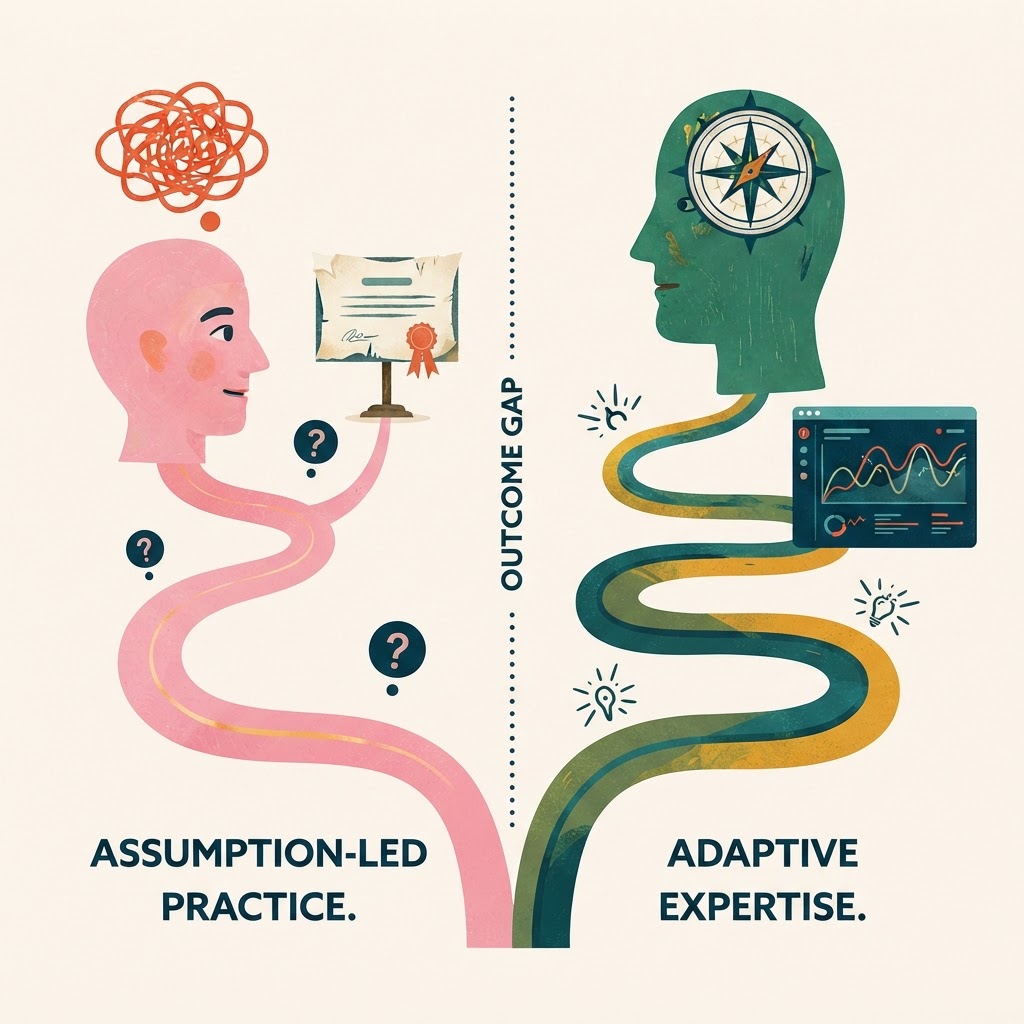
Improvement doesn't come from repeating what you're already good at. It comes from deliberately working on what you find difficult.
Most people assume that experience naturally leads to expertise. It seems like a reasonable assumption. Someone who has worked in the same profession for twenty years should be significantly better than someone with only five years of experience. A musician who has played an instrument every day for a decade should inevitably outperform someone who has practised for only a few years. Sometimes that is true. Often, however, it isn't.
Many people repeat the same level of performance year after year without making meaningful progress. They become efficient at doing what they already know but rarely improve beyond that point. Others, despite having fewer years of experience, continue developing new skills, refining their judgment, and reaching increasingly higher levels of performance. The difference is not simply time. It is the way they practise.
Psychologist Anders Ericsson spent decades studying elite performers across fields as diverse as music, sport, medicine, chess, and business. His research revealed that the world's highest performers rarely became exceptional through repetition alone. Instead, they engaged in a very specific kind of learning known as deliberate practice—a structured approach to improvement that focuses on challenging weaknesses, seeking feedback, and continuously stretching beyond current ability.1
In an age where AI can perform many routine tasks for us, deliberate practice has become even more valuable. It develops the uniquely human capabilities that cannot be built through passive consumption or automated assistance alone.
Practice Is Not the Same as Improvement
Many people confuse practice with repetition. Repeating familiar behaviours certainly creates consistency, but consistency is not the same as improvement. Imagine someone driving a car for twenty years. They may become highly comfortable behind the wheel, but their driving skills probably improve very little after the first few years unless they intentionally work on specific weaknesses. The same principle applies to writing, leadership, communication, programming, and almost every other complex skill.
Deliberate practice begins where comfort ends. Instead of performing tasks we already know how to do, it directs our attention towards the specific aspects of performance that still need improvement. Each practice session has a clear objective, immediate feedback, and measurable progress. Rather than reinforcing existing habits, it deliberately stretches our abilities into unfamiliar territory.
This distinction explains why experience alone is an unreliable predictor of expertise. Improvement requires intentional challenge rather than automatic repetition, and genuine growth occurs when we repeatedly work on the skills that feel just beyond our current level of competence.
The Science Behind Deliberate Practice
Ericsson's research challenged one of the most persistent myths about human performance—the idea that exceptional ability is largely the result of natural talent. While talent undoubtedly influences performance, Ericsson found that sustained improvement depended far more on the quality of practice than on innate ability.2 Elite performers consistently devoted time to activities specifically designed to improve performance rather than simply demonstrate it. Their focus was always on becoming better, not merely proving how good they already were.
These practice sessions shared several characteristics. They focused on clearly defined skills rather than broad goals, provided immediate feedback so mistakes could be corrected quickly, demanded complete concentration rather than divided attention, and pushed individuals slightly beyond their current level of competence. This combination created continuous opportunities for adaptation and growth. Learning occurs most effectively when the challenge is neither too easy nor overwhelmingly difficult. Deliberate practice keeps us in this productive zone where mistakes become valuable information rather than evidence of failure.
Why Feedback Matters
Improvement depends on accurate feedback. Without feedback, we often repeat the same mistakes while believing we are making progress. Because our brains naturally become accustomed to familiar routines, we frequently overlook weaknesses that an outside observer immediately notices. Feedback closes this gap by showing us where our performance differs from our intentions.
This is why elite performers rarely improve in isolation. Athletes rely on coaches. Professional musicians work with instructors. Writers depend on editors. Pilots participate in simulations and structured performance reviews. Across every discipline, feedback accelerates learning because it identifies precisely what needs to improve before those weaknesses become permanent habits.
Importantly, effective feedback is specific rather than general. Being told, "You need to communicate better," provides little practical guidance. Being told, "Your presentation was clear, but your main recommendation wasn't supported by enough evidence," identifies a precise area for improvement and provides direction for the next practice session.
Mistakes Are Part of the Process
Many people interpret mistakes as evidence that they are not good at something. Deliberate practice treats mistakes very differently. Errors are not interruptions to learning; they are the mechanism through which learning occurs. Every mistake provides information about the gap between our intended performance and our actual performance, allowing us to refine our skills more effectively.
When we make a mistake, our brains receive valuable feedback that helps strengthen neural pathways as we correct the error.3 This process explains why activities that feel mentally demanding often produce the greatest improvement. Reading familiar material may feel comfortable, but explaining it from memory is considerably harder. Delivering a presentation without notes creates more challenge than reading prepared slides. Solving unfamiliar problems requires greater effort than repeating familiar exercises.
Rather than avoiding difficulty, deliberate practice embraces it. The struggle itself is often a sign that meaningful learning is taking place because our brains are adapting to demands they have not yet mastered.
Deliberate Practice for Thinking
Deliberate practice is not limited to physical or technical skills. Thinking itself can be practised deliberately. Every time we challenge an assumption, analyse a complex problem, evaluate competing evidence, or reflect on a difficult decision, we exercise the mental abilities that underpin sound judgment. Like any other skill, these cognitive abilities improve through structured repetition and thoughtful feedback.
For example, you might deliberately practise making better decisions by keeping a decision journal and reviewing your reasoning after outcomes become known. You might strengthen critical thinking by reading arguments that challenge your existing beliefs instead of reinforcing them. You might improve your ability to explain complex ideas by teaching them to someone else or writing about them in your own words.
These activities require sustained effort because they force us to think actively rather than passively consume information. That effort is precisely what strengthens cognitive fitness over time.
AI as a Practice Partner
Artificial intelligence offers a remarkable opportunity to support deliberate practice. Instead of asking AI to perform tasks for you, ask it to help you improve your performance. This subtle shift transforms AI from a productivity tool into a learning partner that accelerates skill development without replacing the thinking required for mastery.
Suppose you are learning to write more clearly. Rather than asking AI to generate an article from scratch, write the first draft yourself. Then ask AI to identify weak arguments, unclear explanations, logical gaps, or unsupported assumptions before revising your work and requesting further feedback. If you are learning public speaking, ask AI to evaluate your presentation structure, anticipate audience questions, or suggest where stronger evidence is needed. If you are developing leadership skills, describe a challenging conversation and ask AI to critique your reasoning, identify blind spots, or role-play alternative responses.
In each of these examples, AI does not perform the difficult cognitive work that develops expertise. Instead, it provides timely, personalised feedback that helps you improve more efficiently while ensuring that the learning remains your own.
Progress Is Built One Challenge at a Time
The world's highest performers rarely become exceptional through dramatic breakthroughs. Their success is built through thousands of small improvements accumulated over many years. Each practice session targets one weakness. Every piece of feedback informs the next attempt. Every mistake becomes another opportunity to refine performance. Although individual improvements may appear insignificant, they compound into extraordinary expertise over time.
This gradual process closely mirrors the development of cognitive fitness. Strong thinkers are not born with perfect judgment. They develop it by repeatedly engaging with difficult questions, reflecting on mistakes, seeking constructive criticism, and deliberately stretching their abilities beyond their current level. Every challenge becomes another opportunity to strengthen the mental habits that support lifelong learning.
Artificial intelligence makes knowledge more accessible than ever before, but expertise still depends on deliberate practice. The future will increasingly reward those who use AI not to avoid effort but to make their effort more effective. Deliberate practice ensures that every challenge becomes another opportunity to build stronger skills, deeper understanding, and better thinking.
Try This
Choose one skill you want to improve over the next month. Rather than setting a broad goal such as "become a better writer" or "improve my leadership," identify one specific skill to practise deliberately. Then ask AI:
Help me design a deliberate practice plan for improving [specific skill]. Break the skill into smaller components, identify common mistakes, create progressively more challenging exercises, and provide feedback after each attempt. Focus on improving my thinking rather than doing the work for me.
Review your progress each week and adjust your practice based on the feedback you receive.
Key Takeaways
- Deliberate practice focuses on improving weaknesses rather than repeating existing strengths.
- Experience alone does not guarantee expertise; improvement requires structured challenge and feedback.
- Mistakes are valuable because they reveal where learning should occur.
- AI is most effective when it acts as a coach that provides feedback rather than completing tasks on your behalf.
- Cognitive fitness develops through consistent practice that stretches your thinking beyond your current level of ability.
Continue the Conversation
The AI Thinking Partner Playbook introduces seven practical frameworks for using AI to strengthen—not replace—your thinking. The Cognitive Coach, Teaching Test, and Challenger frameworks show you how to use AI for deliberate practice, structured feedback, and continuous improvement so that every learning experience strengthens your cognitive fitness. Download your free copy and begin practising the skills that matter most in the age of AI.
References
-
Ericsson, K.A., Krampe, R.T. & Tesch-Römer, C. The role of deliberate practice in the acquisition of expert performance. Psychological Review 100, 363–406 (1993).
-
Ericsson, K.A. & Pool, R. Peak: Secrets from the New Science of Expertise. London: Bodley Head (2016).
-
Brown, P.C., Roediger III, H.L. & McDaniel, M.A. Make It Stick: The Science of Successful Learning. Cambridge, MA: Harvard University Press (2014).
-
Ericsson, K.A., Charness, N., Feltovich, P.J. & Hoffman, R.R. (eds.) The Cambridge Handbook of Expertise and Expert Performance. Cambridge: Cambridge University Press (2006).
-
Dunlosky, J. & Metcalfe, J. Metacognition. Thousand Oaks, CA: SAGE Publications (2009).
-
Bjork, R.A. & Bjork, E.L. Making things hard on yourself, but in a good way: Creating desirable difficulties to enhance learning. In: Gernsbacher, M.A., Pew, R.W., Hough, L.M. & Pomerantz, J.R. (eds.) Psychology and the Real World: Essays Illustrating Fundamental Contributions to Society. New York: Worth Publishers, pp. 56–64 (2011).
-
Chi, M.T.H. Active-constructive-interactive: A conceptual framework for differentiating learning activities. Topics in Cognitive Science 1, 73–105 (2009).
Enjoying this article?
Get more like it delivered to your inbox once a month.