Retrieval Practice Beats Rereading
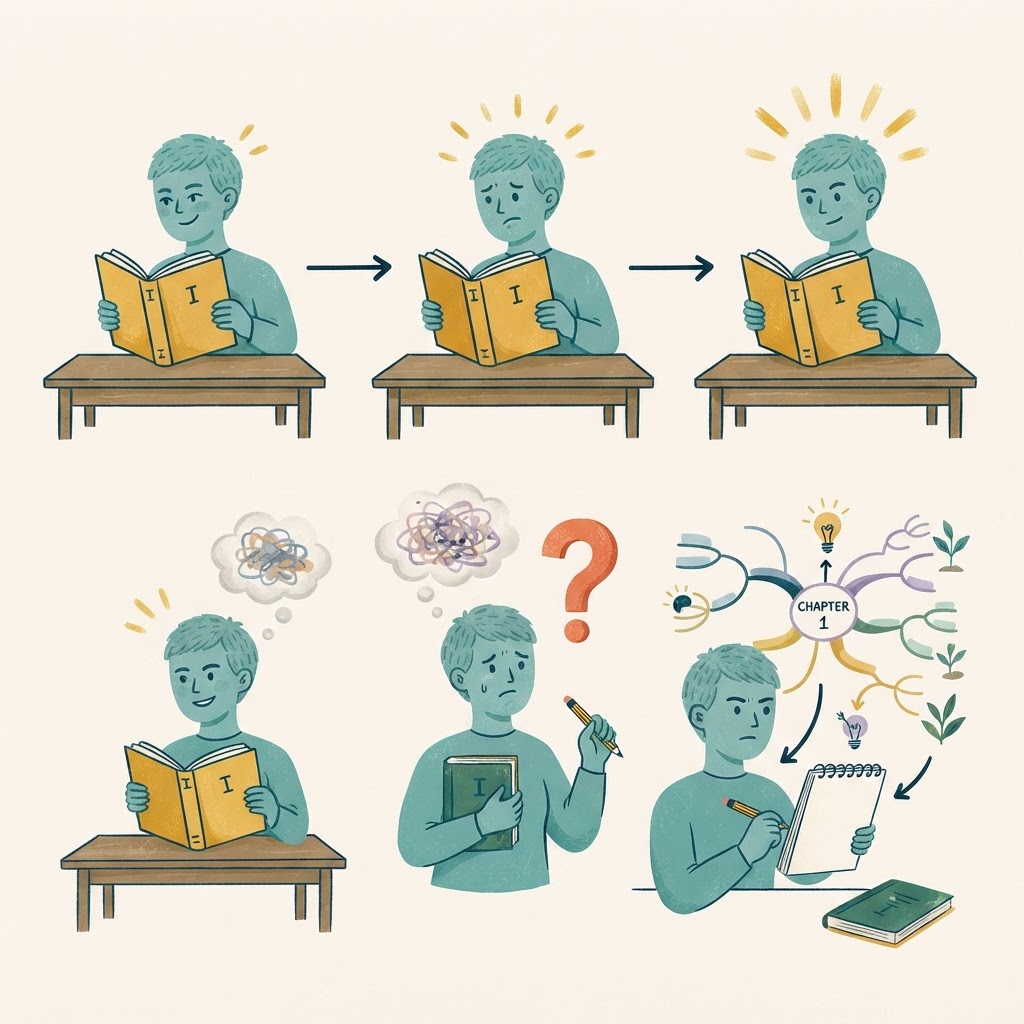
Imagine reading the same chapter of a book three times. Each time, the material feels increasingly familiar. The concepts seem clear, the explanations make sense, and by the final reading you feel confident that you've learned the content.
If you want to remember more, stop reviewing information and start retrieving it.
Imagine reading the same chapter of a book three times. Each time, the material feels increasingly familiar. The concepts seem clear, the explanations make sense, and by the final reading you feel confident that you've learned the content.
A week later, someone asks you to explain what you read. Suddenly, much of that confidence disappears. This experience is surprisingly common because familiarity is not the same as learning. We often mistake recognition for understanding and repeated exposure for long-term memory. Educational research over the past several decades has consistently shown that one of the most effective ways to strengthen learning is not by repeatedly reviewing information, but by actively trying to recall it.1
This process is known as retrieval practice, and it is one of the most powerful, yet underused, learning strategies available. Whether you are studying for an exam, learning a new skill, or using AI to expand your knowledge, retrieval practice can dramatically improve your ability to remember, understand, and apply what you learn.
The Illusion of Learning
Rereading feels productive because it creates a growing sense of familiarity. Difficult passages become easier to follow, key terms seem more recognizable, and each review requires less mental effort than the last. These experiences create the impression that learning is taking place.
Unfortunately, familiarity can be deceptive. Psychologists describe this as an illusion of competence. When information is easy to process because we have recently encountered it, we often assume we have learned it well.2 In reality, familiarity reflects recognition rather than the ability to retrieve and use knowledge independently.
Consider the difference between recognising a familiar face and remembering someone's name. Seeing the person immediately creates a feeling of familiarity, yet recalling their name often requires considerably more effort. Learning works in much the same way. Being able to recognise information when it is presented is fundamentally different from being able to produce it when it matters.
Why Retrieval Strengthens Memory
It might seem intuitive that remembering depends primarily on storing information. Research, however, suggests something more interesting. Every time we retrieve information from memory, we strengthen our ability to retrieve it again in the future.3 Rather than simply measuring what we know, retrieval actively reinforces learning.
This finding has become known as the testing effect or retrieval practice effect. In a landmark study, psychologists Henry Roediger and Jeffrey Karpicke compared students who repeatedly reread material with students who spent time recalling it from memory through testing. Although the rereading group initially felt more confident, the retrieval group performed substantially better on delayed tests of learning.4
These findings challenge one of the most common assumptions about studying. Many people believe tests simply evaluate knowledge after learning has occurred. In reality, well-designed retrieval activities become part of the learning process itself. Every successful attempt to recall information strengthens the mental pathways associated with that knowledge, making future retrieval faster, more accurate, and more durable.
Why Effort Matters
One reason retrieval practice is so effective is that it requires effort. When we struggle to remember something, it can feel as though learning is failing. In fact, the opposite is often true. Psychologists Robert and Elizabeth Bjork describe these productive challenges as desirable difficulties—learning experiences that require greater mental effort but ultimately produce stronger long-term retention.5
Retrieval is difficult precisely because it forces the brain to reconstruct knowledge rather than simply recognise it. That reconstruction strengthens memory and improves future recall. By contrast, rereading becomes progressively easier with repetition. While that ease feels encouraging, it provides relatively little opportunity for the brain to practise recalling information independently.
The discomfort associated with retrieval is therefore not a sign that you are learning poorly. It is often evidence that your brain is doing the work required to build stronger, more durable memories. In learning, ease can sometimes be misleading, while effort is often a reliable indicator of growth.
Retrieval Builds Understanding, Not Just Memory
Retrieval practice is sometimes misunderstood as a technique for memorising isolated facts. Its benefits extend much further because retrieving knowledge strengthens connections between ideas, exposes gaps in understanding, and improves our ability to apply concepts in unfamiliar situations.6
Imagine learning about climate change. Rereading a chapter may help you recognise key terminology, but retrieval practice asks you to explain the greenhouse effect in your own words, compare different climate models, or predict how changes in one part of the system might influence another. These activities require reasoning rather than repetition, making the knowledge more flexible and useful.
The same principle applies across professions. Someone learning leadership might explain key principles without referring to notes. A software engineer might attempt to solve a coding problem before reviewing the solution. A medical student might diagnose a clinical scenario from memory before consulting a textbook. In every case, retrieval transforms passive knowledge into knowledge that can be applied when it matters most.
AI Can Either Replace Retrieval or Strengthen It
Artificial intelligence has made accessing information almost effortless. Whenever we forget something, we can simply ask AI for the answer. While this convenience is valuable, it also creates a subtle risk. If AI always retrieves information on our behalf, we lose opportunities to practise retrieving it ourselves.
Imagine reading an article and immediately asking AI to summarise it. The summary may be accurate, concise, and helpful, but your brain has done very little of the work required for durable learning. Now imagine a different approach. After reading the article, you close it, write down everything you can remember, explain the central ideas in your own words, and identify what you found confusing. Only then do you ask AI to compare your explanation with the original, identify omissions, challenge misconceptions, and deepen your understanding.
The difference between these two approaches is significant. In the first example, AI replaces retrieval. In the second, AI strengthens retrieval by providing feedback after your own memory has been tested. This reflects one of Flow Directive's central principles: AI should augment thinking rather than eliminate the mental effort that develops it.
Practical Ways to Use Retrieval Practice
Retrieval practice does not require elaborate study systems or specialised software. Its effectiveness comes from regularly asking your brain to produce information without immediately looking at the answer. The method is simple, but its impact is profound.
You might close a book and explain the main ideas from memory before reviewing your notes. After attending a meeting, write down everything you remember before reading the minutes. Teach a concept to someone else without referring to supporting material. Create your own questions before checking the answers, or ask AI to quiz you instead of explaining the topic immediately.
Notice what these strategies have in common. Each begins with retrieval rather than review. The goal is not perfect recall but repeated practice. Every successful retrieval strengthens learning, while every unsuccessful retrieval reveals where additional learning is needed.
Learning That Lasts
Modern technology has made information abundant. The challenge is no longer finding knowledge but retaining it, understanding it, and applying it wisely. Retrieval practice addresses this challenge by changing the way we think about learning. Instead of treating memory as a passive storage system, it recognises that remembering is an active skill that improves through use.
This idea has important implications for the age of AI. As intelligent systems become increasingly capable of recalling information instantly, our competitive advantage will depend less on accessing knowledge and more on understanding it deeply enough to reason with it, connect it to other ideas, and apply it thoughtfully. Retrieval practice helps build that capability because it transforms learning from passive consumption into active participation.
The effort involved in remembering is not an obstacle to learning. It is one of the reasons learning happens in the first place.
Try This
The next time you finish reading a chapter, article, or report, resist the urge to review it immediately.
Instead:
- Close the material.
- Write down everything you can remember.
- Explain the key ideas in your own words.
- Identify anything you're unsure about.
- Then ask AI to compare your explanation with the original, identify gaps in your understanding, and quiz you on the concepts you found most difficult.
Notice how much more deeply you engage with the material when retrieval comes before review.
Key Takeaways
- Retrieval practice strengthens learning by requiring the brain to actively recall information.
- Rereading often creates an illusion of learning because familiarity is mistaken for understanding.
- Effortful retrieval improves long-term retention more effectively than passive review.
- Retrieval strengthens reasoning and application, not just memory.
- AI becomes a powerful learning partner when it supports retrieval rather than replacing it.
Continue the Conversation
The AI Thinking Partner Playbook introduces seven practical frameworks for using AI to strengthen—not replace—your thinking. The Socratic Guide framework demonstrates how AI can become an active learning partner by questioning, quizzing, and challenging your understanding instead of simply providing answers. Download your free copy and begin building the cognitive fitness needed to thrive in the age of AI.
References
-
Brown, P.C., Roediger III, H.L. & McDaniel, M.A. Make It Stick: The Science of Successful Learning. Cambridge, MA: Harvard University Press (2014).
-
Dunlosky, J., Rawson, K.A., Marsh, E.J., Nathan, M.J. & Willingham, D.T. Improving students' learning with effective learning techniques: Promising directions from cognitive and educational psychology. Psychological Science in the Public Interest 14, 4–58 (2013).
-
Karpicke, J.D. Retrieval-based learning: Active retrieval promotes meaningful learning. Current Directions in Psychological Science 21, 157–163 (2012).
-
Roediger III, H.L. & Karpicke, J.D. Test-enhanced learning: Taking memory tests improves long-term retention. Psychological Science 17, 249–255 (2006).
-
Bjork, R.A. & Bjork, E.L. Making things hard on yourself, but in a good way: Creating desirable difficulties to enhance learning. In: Gernsbacher, M.A., Pew, R.W., Hough, L.M. & Pomerantz, J.R. (eds.) Psychology and the Real World: Essays Illustrating Fundamental Contributions to Society. New York: Worth Publishers, pp. 56–64 (2011).
-
Fiorella, L. & Mayer, R.E. Learning as a Generative Activity: Eight Learning Strategies That Promote Understanding. Cambridge: Cambridge University Press (2015).
Enjoying this article?
Get more like it delivered to your inbox once a month.