Cognitive Biases Worth Knowing
Imagine you're interviewing two candidates for a role. The first makes an outstanding impression within the first five minutes. They're confident, articulate, and personable. The second is quieter, more reserved, and takes longer to warm up. By the end of the interviews, you find yourself favouring the first candidate, even though both have similar qualifications and experience.
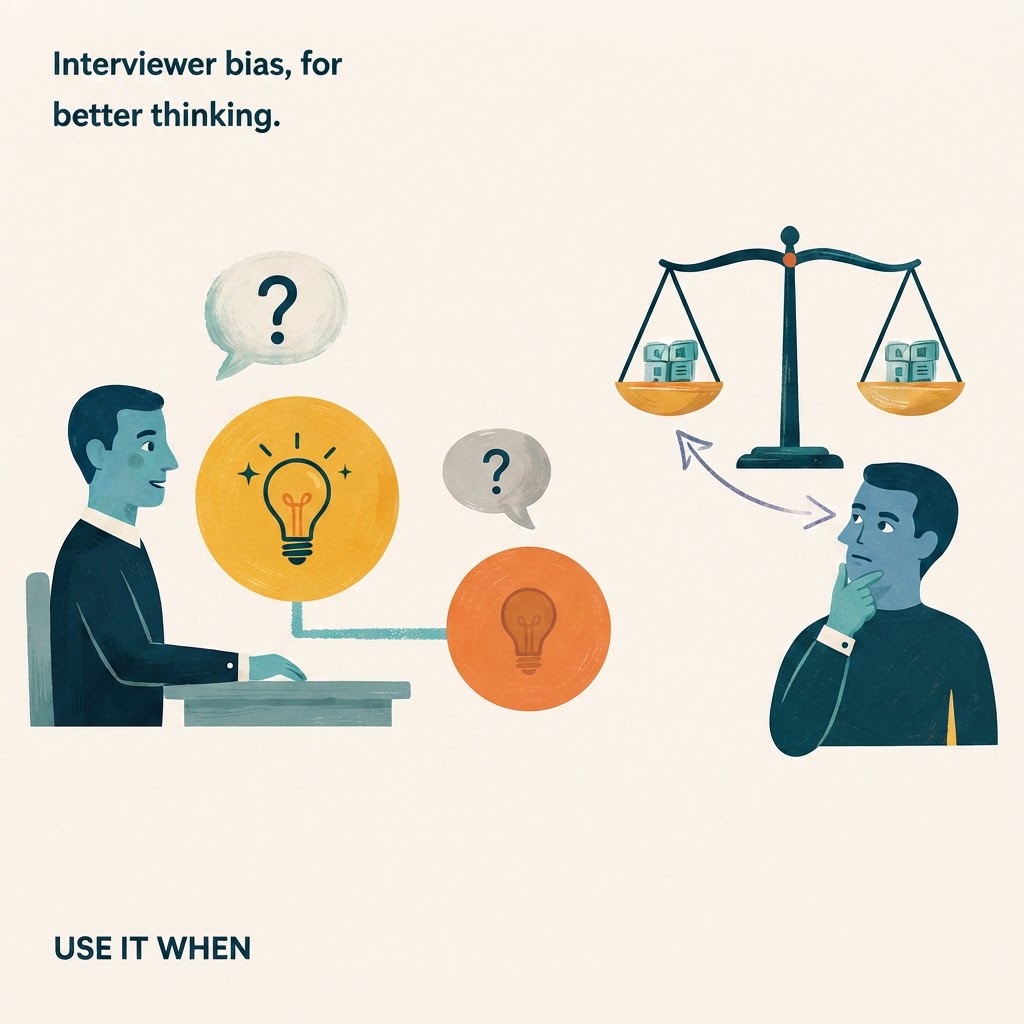
The biggest obstacles to good thinking are often invisible because they exist inside our own minds.
Imagine you're interviewing two candidates for a role. The first makes an outstanding impression within the first five minutes. They're confident, articulate, and personable. The second is quieter, more reserved, and takes longer to warm up. By the end of the interviews, you find yourself favouring the first candidate, even though both have similar qualifications and experience.
Or perhaps you read a headline that perfectly matches your existing beliefs. Without thinking too deeply, you accept it as credible and share it with a colleague. A few days later, you discover the story omitted important evidence that painted a very different picture.
These situations are surprisingly common because our brains are designed to make fast judgments. Most of the time, these mental shortcuts are incredibly useful. They allow us to navigate an overwhelmingly complex world without analysing every decision from first principles. Occasionally, however, the same shortcuts systematically distort our thinking.
Psychologists call these distortions cognitive biases. They are not signs of low intelligence or poor judgment. They are predictable patterns that affect almost everyone.1 Learning to recognise them is one of the most effective ways to improve reasoning, make better decisions, and use AI more thoughtfully.
Why the Brain Uses Mental Shortcuts
Every day, the human brain processes an extraordinary amount of information.
If we analysed every decision with complete precision, even simple tasks would become exhausting. Instead, the brain relies on heuristics—mental shortcuts that allow us to make rapid judgments using limited information.2 These shortcuts are remarkably efficient. They help us recognise faces instantly, avoid obvious dangers, and make thousands of routine decisions without conscious effort.
The trade-off is that speed sometimes comes at the expense of accuracy.
Heuristics evolved for environments very different from today's world. They served our ancestors well when making quick decisions about threats, food, or social relationships. In modern environments filled with complex information, media, algorithms, and artificial intelligence, those same shortcuts can occasionally lead us astray.
Recognising cognitive biases does not eliminate them completely. It does, however, give us an opportunity to slow down and think more deliberately when the stakes are high.
Confirmation Bias
One of the most well-known cognitive biases is confirmation bias—our tendency to seek, notice, and remember information that supports what we already believe while paying less attention to information that challenges those beliefs.3
Imagine someone who believes remote work always increases productivity. They may enthusiastically collect stories of successful remote companies while overlooking evidence showing that outcomes vary depending on leadership, communication, and organisational culture.
Confirmation bias influences much more than politics or public debate. It affects hiring decisions, investment choices, product development, relationships, and even scientific research. Once we develop an opinion, our minds naturally begin searching for evidence that reinforces it.
Strong thinkers deliberately push against this tendency. Rather than asking, "What evidence proves I'm right?", they ask, "What evidence would convince me I'm wrong?" That single question often reveals information we might otherwise ignore.
Anchoring Bias
The first piece of information we encounter often influences every judgment that follows.
This tendency, known as anchoring bias, affects decisions ranging from salary negotiations to purchasing a house. Even when the initial number is arbitrary, it subtly shapes our expectations and subsequent estimates.4
Suppose you see a jacket originally priced at $400 that is now discounted to $220. The original price becomes an anchor, making the sale appear particularly attractive. Whether the jacket is actually worth $220 becomes a secondary consideration.
Anchoring also influences professional decision-making. Initial project estimates affect future budgeting. First impressions influence performance evaluations. Early forecasts shape strategic planning even after new evidence becomes available.
One way to reduce anchoring is to generate your own estimate before seeing external information. By establishing an independent point of reference, you become less susceptible to someone else's anchor.
Availability Bias
Have you ever become more worried about flying after seeing extensive media coverage of a plane accident?
This reaction illustrates the availability heuristic. We estimate how common or likely something is based on how easily examples come to mind rather than on actual probabilities.5
Events that are dramatic, emotional, or widely reported feel more common because they are easier to remember. Meanwhile, more frequent but less memorable risks often receive less attention.
Availability bias influences many everyday decisions. Investors become overly optimistic after hearing repeated success stories. Consumers overestimate rare dangers after watching sensational news coverage. Organisations sometimes focus resources on highly visible problems while neglecting quieter but more significant risks.
Thinking statistically rather than emotionally helps counter this bias. Instead of asking what examples come to mind most easily, ask what the broader evidence actually shows.
Outcome Bias
One of the most misleading ways to judge a decision is by looking only at its outcome.
Suppose a company launches a risky product without adequate research, and the product becomes a commercial success. Was it a good decision?
Perhaps.
Or perhaps the company simply got lucky.
Outcome bias causes us to judge the quality of a decision according to what happened afterwards rather than according to the reasoning available at the time.6 This makes learning difficult because success can reinforce poor thinking, while failure can discourage excellent judgment.
Good decisions are based on evidence, thoughtful reasoning, and an honest assessment of uncertainty. Outcomes, however, are also influenced by factors beyond our control.
This is why practices such as decision journals are so valuable. They preserve our reasoning before outcomes become known, allowing us to evaluate our thinking rather than our luck.
The Halo Effect
Our impressions rarely remain isolated.
If we perceive someone as intelligent, attractive, charismatic, or successful in one area, we often assume they possess other positive qualities as well. Psychologists refer to this tendency as the halo effect.7
The halo effect explains why first impressions carry so much influence. A confident speaker may seem more credible even when their evidence is weak. A successful entrepreneur may be assumed to possess expertise far beyond their actual experience. A prestigious brand may cause consumers to overlook flaws that would be criticised in a lesser-known competitor.
This bias reminds us to separate evidence from impression.
Instead of asking whether we like someone, we should ask whether the evidence actually supports the conclusion we are reaching.
AI Doesn't Remove Bias
Artificial intelligence can help us think more effectively, but it does not automatically eliminate cognitive bias.
In some situations, AI can reduce bias by encouraging us to consider additional evidence, compare multiple viewpoints, or identify logical inconsistencies. In other situations, however, AI may unintentionally reinforce our existing beliefs because the prompts we provide reflect our own assumptions.
Imagine asking AI:
"Why is my strategy the best option?"
The question itself assumes your strategy is already correct.
Now compare that with:
"What are the strongest arguments against my strategy?"
"What assumptions am I making?"
"How would someone who disagrees with me interpret this evidence?"
The quality of AI's responses often depends on the quality of our questions. When we use AI to challenge our thinking instead of confirming it, it becomes a powerful tool for reducing bias rather than amplifying it.
Awareness Creates Better Judgment
No one is free from cognitive bias.
Experience does not eliminate it. Intelligence does not eliminate it. Even experts are vulnerable because biases arise from the normal operation of the human mind rather than from a lack of knowledge.
The goal, therefore, is not perfect objectivity.
The goal is becoming aware of the situations where our thinking is most likely to drift away from evidence. Awareness creates opportunities to slow down, seek alternative perspectives, and examine assumptions before making important decisions.
This habit lies at the heart of cognitive fitness. Strong thinkers are not people who never make mistakes. They are people who recognise that good thinking requires continual self-correction. They become increasingly skilled at questioning their own judgments with the same curiosity they apply to the ideas of others.
Artificial intelligence makes information easier to access than ever before, but it cannot remove the biases that shape human judgment. What it can do is help us recognise them—provided we are willing to ask questions that challenge rather than comfort our thinking.
Try This
The next time you're making an important decision, ask AI to act as your bias checker.
Use prompts such as:
- What cognitive biases might be influencing my thinking?
- What evidence am I ignoring?
- What would someone with the opposite view argue?
- Which assumptions have I accepted without questioning?
- If I had to defend the opposite conclusion, what would I say?
Notice how the conversation changes when AI challenges your reasoning instead of reinforcing it.
Key Takeaways
- Cognitive biases are predictable mental shortcuts that can distort judgment.
- Confirmation bias, anchoring, availability bias, outcome bias, and the halo effect influence everyday decisions.
- Recognising bias is the first step toward making more thoughtful, evidence-based decisions.
- AI can either reinforce biases or help reduce them depending on how we use it.
- Cognitive fitness includes developing the habit of questioning our own assumptions as carefully as we question those of others.
Continue the Conversation
The AI Thinking Partner Playbook introduces seven practical frameworks for using AI to strengthen—not replace—your thinking. The Challenger framework helps you identify assumptions, expose cognitive biases, and invite AI to critique your reasoning before important decisions. Download your free copy and begin developing the cognitive fitness needed to think more clearly in the age of AI.
References
-
Kahneman, D. Thinking, Fast and Slow. London: Penguin Books (2011).
-
Tversky, A. & Kahneman, D. Judgment under uncertainty: Heuristics and biases. Science 185, 1124–1131 (1974).
-
Nickerson, R.S. Confirmation bias: A ubiquitous phenomenon in many guises. Review of General Psychology 2, 175–220 (1998).
-
Tversky, A. & Kahneman, D. Judgment under uncertainty: Heuristics and biases. Science 185, 1124–1131 (1974).
-
Tversky, A. & Kahneman, D. Availability: A heuristic for judging frequency and probability. Cognitive Psychology 5, 207–232 (1973).
-
Baron, J. Thinking and Deciding. 4th edn. Cambridge: Cambridge University Press (2008).
-
Nisbett, R.E. & Wilson, T.D. The halo effect: Evidence for unconscious alteration of judgments. Journal of Personality and Social Psychology 35, 250–256 (1977).
Enjoying this article?
Get more like it delivered to your inbox once a month.