Mental Models Everyone Should Know
Imagine two people facing the same problem. Both have access to the same information. Both are equally intelligent. Both have years of relevant experience. Yet one consistently identifies patterns, anticipates consequences, and arrives at better decisions. The difference is often not knowledge itself but the mental frameworks used to interpret it.
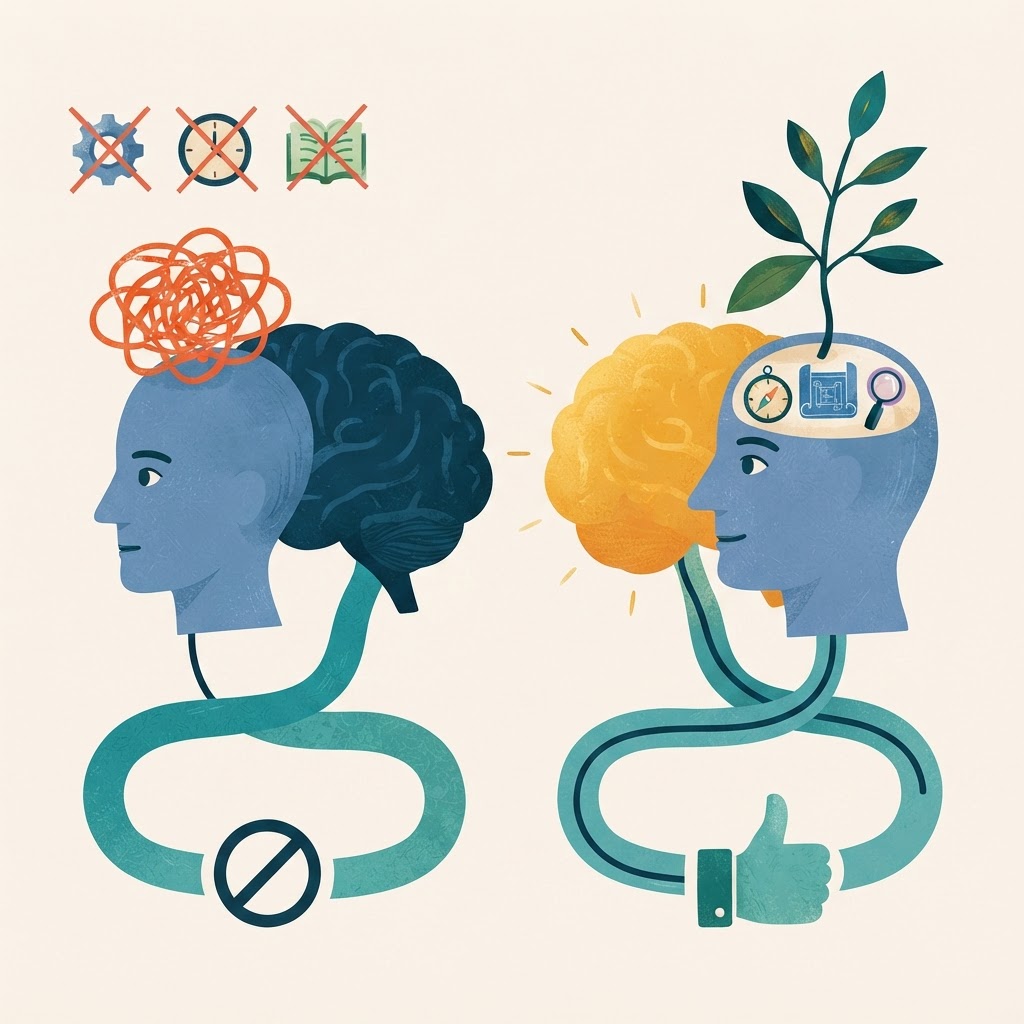
The quality of your decisions depends less on how much you know and more on how you organise what you know.
Imagine two people facing the same problem. Both have access to the same information. Both are equally intelligent. Both have years of relevant experience. Yet one consistently identifies patterns, anticipates consequences, and arrives at better decisions. The difference is often not knowledge itself but the mental frameworks used to interpret it.
These frameworks are known as mental models. They are simplified representations of how the world works, helping us understand complex situations, make predictions, and solve problems more effectively. Rather than memorising isolated facts, strong thinkers develop a collection of mental models that allow them to view challenges from multiple perspectives.1
In an age where artificial intelligence can retrieve almost any piece of information within seconds, the ability to think using powerful mental models is becoming increasingly valuable. Information tells us what is happening. Mental models help us understand why.
What Are Mental Models?
A mental model is a way of explaining or interpreting reality. Some models come from economics, others from psychology, biology, engineering, mathematics, or physics. None of them perfectly describe the world, but each provides a useful lens through which to understand a particular problem.
Charlie Munger, the investor and long-time business partner of Warren Buffett, famously argued that the world's greatest thinkers build a latticework of mental models drawn from multiple disciplines.2 Rather than relying on expertise from only one field, they combine ideas from many different areas to develop richer understanding.
Complex problems rarely belong to a single discipline. Climate change involves science, economics, politics, psychology, and technology. Building a successful business requires understanding customers, finance, design, leadership, and systems. Better thinking therefore depends on having multiple ways of interpreting the same situation. Mental models provide those different perspectives.
First-Principles Thinking
One of the most valuable mental models involves reasoning from first principles.
Instead of accepting existing assumptions or copying what others have done, first-principles thinking breaks a problem down into its most fundamental truths before rebuilding a solution from the ground up.3
Consider someone designing a new product. A conventional approach might begin by asking, "How do other companies solve this problem?"
A first-principles approach asks:
"What problem are we actually trying to solve?"
"Which assumptions are genuinely true, and which are simply habits?"
By separating facts from assumptions, first-principles thinking creates opportunities for innovation that analogy alone often misses.
Opportunity Cost
Every decision involves trade-offs. Economists describe the value of the next best alternative that we give up as the opportunity cost.4
Suppose you spend an evening watching television. The financial cost may be zero. The opportunity cost, however, includes everything else you could have done with that time—reading, exercising, learning a new skill, spending time with family, or resting.
Opportunity cost reminds us that resources are limited. Every "yes" to one activity is automatically a "no" to another. Strong thinkers therefore ask not only whether something is worthwhile but whether it is the best use of their limited time, energy, attention, and money.
Second-Order Thinking
Many decisions have consequences beyond their immediate effects.
First-order thinking focuses on what happens next.
Second-order thinking asks what happens after that.5
Imagine a company cutting employee training to reduce costs. The first-order consequence is clear: expenses decrease. The second-order consequences may include lower employee capability, reduced innovation, weaker customer service, and higher staff turnover. The short-term benefit creates long-term costs that are less immediately visible. Second-order thinking encourages us to look beyond immediate outcomes and consider the broader chain of consequences that follows every important decision.
Inversion
Sometimes the easiest way to solve a problem is to turn it upside down. Mathematician Carl Jacobi famously advised people to invert, always invert.6 Instead of asking:
"How can I build a successful business?"
Ask:
"What would almost guarantee failure?"
Perhaps ignoring customers, avoiding feedback, refusing to adapt, and neglecting quality. Once these mistakes become obvious, avoiding them often proves easier than identifying the perfect strategy for success.
Inversion is valuable because our brains sometimes recognise errors more easily than optimal solutions. By examining failure first, we uncover insights that might otherwise remain hidden.
Feedback Loops
Many systems reinforce themselves over time. Some create positive cycles that strengthen desirable outcomes. Others create negative cycles that amplify problems. These are known as feedback loops, a central concept in systems thinking.7
Imagine someone who begins exercising regularly. Improved fitness increases energy levels. Higher energy makes exercise feel easier. Greater consistency produces better health, creating further motivation to continue.
The opposite cycle is equally possible. Poor sleep reduces energy. Lower energy discourages exercise. Less exercise contributes to poorer sleep, reinforcing the original problem. Recognising feedback loops helps us focus on changing the underlying system rather than reacting only to individual events.
Probabilistic Thinking
Many people search for certainty when certainty simply does not exist. Probabilistic thinking recognises that most important decisions involve uncertainty.8 Rather than asking whether something will happen, probabilistic thinkers ask how likely different outcomes are and how confident they should be in those estimates. This mindset encourages flexibility.
Instead of becoming emotionally attached to a single prediction, we remain willing to update our beliefs as new evidence emerges. Scientists, investors, physicians, and professional forecasters all rely heavily on probabilistic thinking because it reflects the reality of an uncertain world. Thinking in probabilities encourages intellectual humility while improving decision-making under uncertainty.
AI Is More Powerful When Guided by Mental Models
Artificial intelligence excels at generating information. Mental models help us determine which information matters. Without clear frameworks, AI conversations often become collections of disconnected facts. With mental models, however, AI becomes a powerful thinking partner capable of exploring problems from multiple perspectives.
Imagine asking AI:
"Help me evaluate this decision using first-principles thinking."
"What second-order consequences might I be overlooking?"
"What opportunity costs am I ignoring?"
"What feedback loops could emerge from this strategy?"
"Challenge my assumptions using inversion."
Instead of producing generic advice, AI begins supporting structured reasoning. The quality of your thinking becomes less dependent on AI's answers and more dependent on the models you use to guide the conversation.
Building Your Own Latticework
No single mental model explains every situation. Every model simplifies reality by highlighting certain features while overlooking others. The goal is therefore not to find one perfect framework but to develop a diverse collection of complementary models that can be applied flexibly across different contexts.
This is why mental models are such an important part of cognitive fitness. They strengthen our ability to recognise patterns, question assumptions, evaluate trade-offs, and make thoughtful decisions in uncertain environments.
Artificial intelligence will continue making knowledge more accessible than ever before. The people who thrive will not necessarily be those who know the most facts. They will be those who know how to organise those facts into meaningful patterns, draw insights from multiple disciplines, and apply the right mental model at the right time.
Knowledge fills the toolbox. Mental models teach you which tool to use.
Try This
Think about an important decision you're currently facing. Ask AI to analyse it using five different mental models:
- First-principles thinking
- Opportunity cost
- Second-order thinking
- Inversion
- Feedback loops
Compare the answers. Notice how each model highlights different aspects of the same problem. Then ask yourself:
- Which model changed my perspective the most?
- What assumptions did I uncover?
- Which consequences had I overlooked?
- What new questions emerged?
Key Takeaways
- Mental models are frameworks that help us understand complexity and make better decisions.
- Strong thinkers draw models from multiple disciplines rather than relying on a single perspective.
- First principles, opportunity cost, second-order thinking, inversion, feedback loops, and probabilistic thinking are valuable models for everyday life.
- AI becomes a more effective thinking partner when guided by mental models rather than used only for information retrieval.
- Building a diverse collection of mental models strengthens cognitive fitness and improves long-term judgment.
Continue the Conversation
The AI Thinking Partner Playbook introduces seven practical frameworks for using AI to strengthen—not replace—your thinking. The First-Principles Co-pilot, Scenario Builder, and Perspective Expander frameworks help you apply powerful mental models, explore alternative viewpoints, and make more thoughtful decisions with AI. Download your free copy and begin building the cognitive fitness needed to navigate an increasingly complex world.
References
-
Johnson-Laird, P.N. Mental Models: Towards a Cognitive Science of Language, Inference and Consciousness. Cambridge, MA: Harvard University Press (1983).
-
Munger, C.T. Poor Charlie's Almanack: The Essential Wit and Wisdom of Charles T. Munger. 3rd edn. Virginia Beach, VA: Donning Company Publishers (2005).
-
Aristotle. Metaphysics. Translated by W.D. Ross. In: Barnes, J. (ed.) The Complete Works of Aristotle. Princeton: Princeton University Press (1984).
-
Mankiw, N.G. Principles of Economics. 9th edn. Boston: Cengage Learning (2020).
-
Dobelli, R. The Art of Thinking Clearly. London: Sceptre (2013).
-
Jacobi, C.G.J. Quoted in Pólya, G. How to Solve It. 2nd edn. Princeton: Princeton University Press (1957).
-
Meadows, D.H. Thinking in Systems: A Primer. White River Junction, VT: Chelsea Green Publishing (2008).
-
Tetlock, P.E. & Gardner, D. Superforecasting: The Art and Science of Prediction. London: Random House (2015).
Enjoying this article?
Get more like it delivered to your inbox once a month.