Thinking in Probabilities
Imagine you're deciding whether to accept a new job. The salary is higher than your current role, but the company is a relatively young start-up. It could grow rapidly over the next five years, creating exciting opportunities, or it could struggle financially and disappear altogether. No amount of research can tell you exactly what will happen.
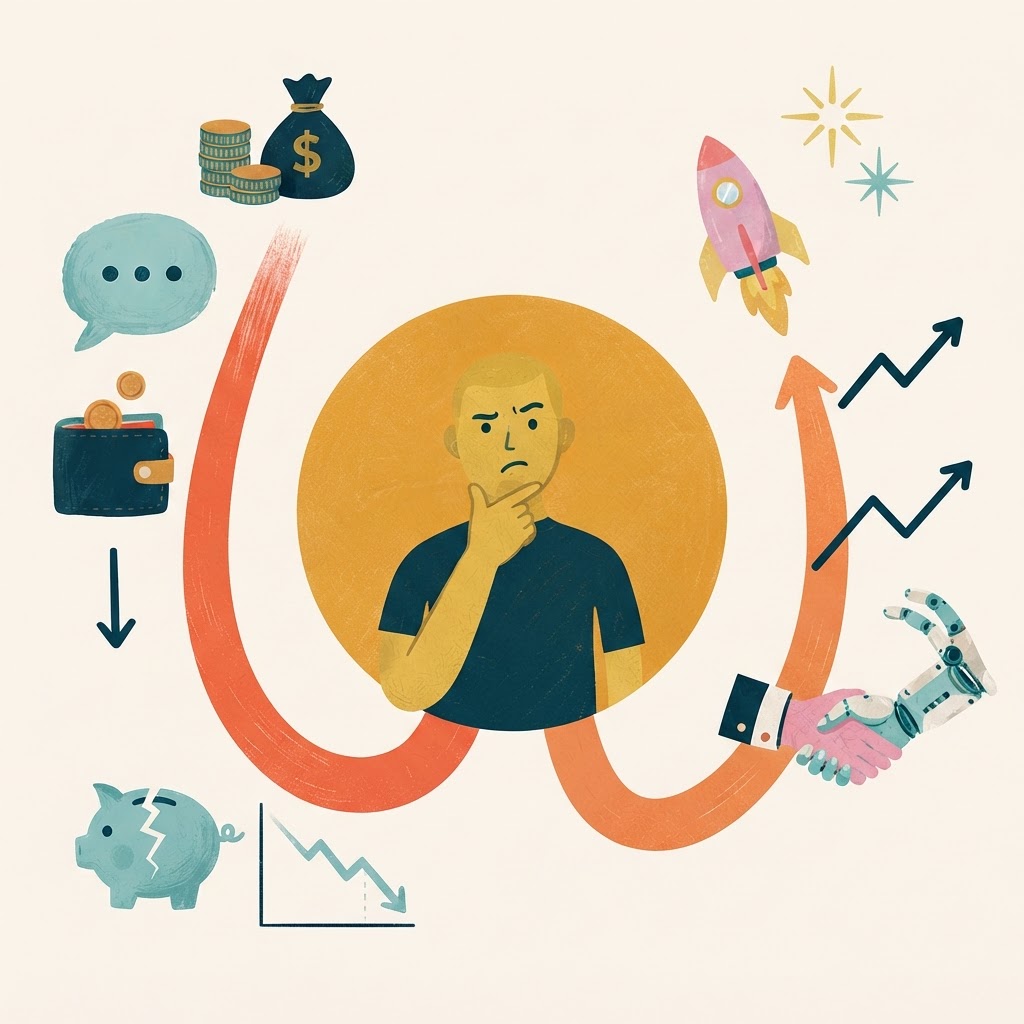
The best decisions are rarely based on certainty. They are based on weighing the likelihood of different outcomes.
Imagine you're deciding whether to accept a new job. The salary is higher than your current role, but the company is a relatively young start-up. It could grow rapidly over the next five years, creating exciting opportunities, or it could struggle financially and disappear altogether. No amount of research can tell you exactly what will happen.
The same uncertainty appears whenever we launch a new product, invest our savings, choose a university degree, hire a new employee, or adopt an emerging technology. Every meaningful decision involves incomplete information because the future has not happened yet. Despite this, many of us approach decisions as though there must be a single correct answer waiting to be discovered. We become uncomfortable when certainty remains out of reach, even though uncertainty is an unavoidable feature of almost every important choice.
The strongest thinkers approach uncertainty differently. Rather than asking, "What will happen?", they ask, "What is most likely to happen, and how confident should I be?" That subtle shift changes the goal of decision-making. Instead of chasing impossible certainty, we learn to estimate probabilities, compare risks, and remain willing to adjust our thinking as new evidence emerges.
The Future Is Inherently Uncertain
One of the most important lessons from psychology and decision science is that uncertainty is not a flaw in our reasoning. It is a characteristic of reality itself. Financial markets respond to political events, technological innovation, consumer behaviour, and countless other variables. Medical treatments work differently for different individuals. Businesses succeed or fail because of combinations of factors that often become clear only in hindsight.
Our discomfort with uncertainty often leads us to search for definitive answers where none exist. We want experts to tell us exactly what will happen, headlines to provide simple conclusions, and AI to produce the correct solution. While expertise and technology can improve our understanding, neither can eliminate uncertainty from complex decisions.
Recognising this changes the way we think. Good decision-makers do not attempt to predict the future with perfect accuracy because they understand that this is impossible. Instead, they focus on making the best possible estimates using the evidence currently available, while accepting that every estimate remains open to revision.1
Confidence Is Not the Same as Accuracy
One of the easiest mistakes to make is confusing confidence with correctness. People who speak with certainty often appear more persuasive than those who openly acknowledge uncertainty, yet decades of research show that confidence is only weakly related to accuracy.2 Someone can express complete certainty while being entirely mistaken, whereas thoughtful experts frequently express caution precisely because they understand the complexity of the problem.
This creates an important challenge in the age of AI and social media. Online platforms reward certainty because bold predictions attract attention, generate engagement, and spread more rapidly than nuanced discussion. Complex issues are frequently presented as though there are only two opposing positions, leaving little room for ambiguity or evolving evidence.
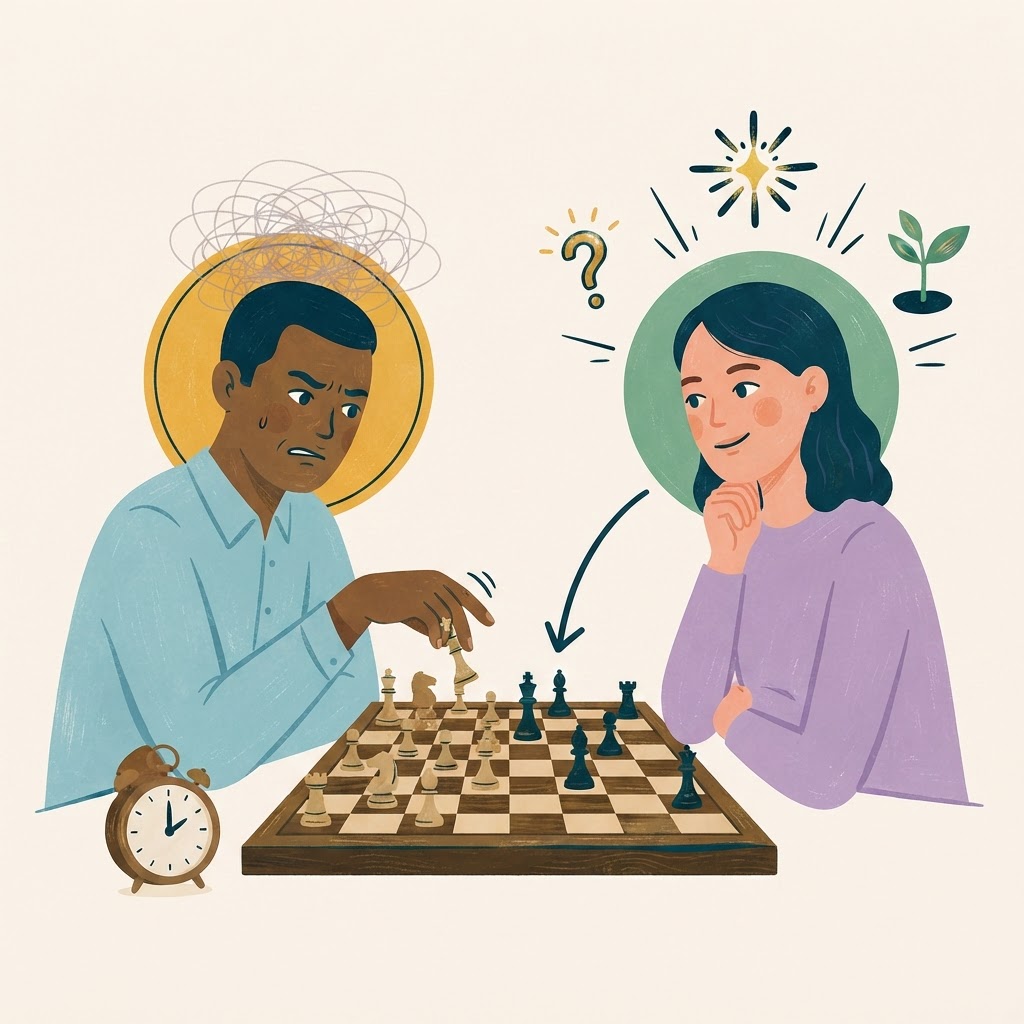
Strong thinkers resist this pressure. They understand that saying, "I'm 70% confident," is often more intellectually honest than declaring absolute certainty. Expressing uncertainty is not a sign of indecision or weakness. It reflects an accurate appreciation of the limits of our knowledge and a willingness to update our views when new evidence becomes available.
Thinking Like a Forecaster
Psychologist Philip Tetlock spent decades studying people whose job was to predict future events, from political developments to economic change.3 His research found that the most accurate forecasters shared a remarkably consistent set of habits. They rarely made absolute predictions, expressed their expectations as probabilities, and continually revised those estimates as circumstances changed.
This approach allowed them to improve over time because every prediction became an opportunity to calibrate their judgment. Estimating that an event has a 70% chance of occurring is not a claim of certainty. It is a recognition that multiple outcomes remain possible while one appears more likely than the others based on the available evidence.
Probabilistic thinking also reduces attachment to our own opinions. When beliefs are expressed as estimates rather than certainties, changing our minds becomes a natural response to new information instead of an admission of failure.
Avoiding the Trap of Binary Thinking
Human beings naturally simplify complexity by dividing ideas into categories such as true or false, success or failure, or good or bad. Although this tendency makes the world feel easier to understand, it often obscures the richer reality that lies between these extremes.
Imagine a company launching a new product that generates moderate sales but falls short of ambitious financial targets. Judged solely by its commercial performance, the launch might appear disappointing. Yet it may also reveal valuable customer insights, strengthen relationships with key partners, improve internal capabilities, or identify promising opportunities for future innovation. Whether the project was a success or a failure depends entirely on the criteria being used.
Thinking in probabilities encourages us to move beyond binary labels and recognise that most outcomes exist on a spectrum. Decisions should not be judged only by their eventual results but also by the quality of the reasoning that produced them. A thoughtful decision made under uncertainty remains a good decision even if events later unfold in unexpected ways.
Better Decisions Do Not Always Produce Better Outcomes
One of the most difficult ideas in decision science is that good decisions and good outcomes are not always the same thing. Chance influences every complex system, meaning that even excellent reasoning can sometimes produce disappointing results. Equally, poor decisions occasionally succeed simply because circumstances happen to be favourable.
Imagine deciding not to carry an umbrella after checking a reliable weather forecast showing only a 10% chance of rain. If it rains unexpectedly, you may get wet, but that does not mean the decision itself was irrational. Given the evidence available at the time, accepting a small risk was entirely reasonable.
Psychologists refer to the tendency to judge decisions solely by their outcomes as outcome bias.4 This bias encourages us to believe that successful outcomes must reflect good decisions and unsuccessful outcomes must reflect poor ones. In reality, evaluating decisions requires examining the reasoning, evidence, assumptions, and alternatives that were available before the outcome was known.
AI Can Help You Think Probabilistically
Artificial intelligence is particularly valuable when exploring uncertainty because it can rapidly generate alternative scenarios, compare competing possibilities, identify hidden assumptions, and highlight risks that might otherwise be overlooked. Used thoughtfully, it encourages more structured decision-making without pretending to eliminate uncertainty.
Rather than asking AI to predict the future, ask it to explore different possibilities. Questions such as "What are the three most likely outcomes?", "Which assumptions am I relying on?", "What evidence would change my confidence?", and "What important risks have I overlooked?" encourage a richer exploration of uncertainty than simply requesting the correct answer.
This approach transforms AI into a thinking partner rather than an oracle. Its greatest value lies in helping us think more carefully about uncertainty, not in replacing our judgment with artificial certainty.
Thinking in Bets Rather Than Certainties
Former professional poker player Annie Duke argues that every important decision is essentially a bet on the future.5 Even when we make careful decisions supported by strong evidence, we are still placing a wager that one course of action is more likely to produce a desirable outcome than another.
Viewing decisions in this way changes how we respond when events unfold differently from our expectations. Instead of treating unexpected outcomes as proof that we were wrong, we recognise that uncertainty was always part of the process. The more useful question becomes whether the decision represented a thoughtful assessment of the available evidence rather than whether it happened to produce the desired result.
This perspective encourages continuous learning because every decision becomes an opportunity to improve our judgment. Rather than protecting our egos by insisting we were right, we become interested in calibrating our confidence and refining our ability to estimate probabilities more accurately over time.
Better Thinking Means Better Estimates
Many people assume that intelligent thinkers possess certainty. In practice, exceptional judgment often comes from recognising where certainty is impossible and where confidence should remain provisional. Skilled decision-makers understand when the evidence is strong, when uncertainty remains high, and when additional information is worth seeking before acting.
This mindset lies at the heart of cognitive fitness. Strong thinkers treat their beliefs as working hypotheses rather than permanent conclusions. They compare evidence, revise their opinions when circumstances change, and understand that intellectual humility is not a weakness but a strength. They recognise that while the future cannot be predicted with complete certainty, it can often be understood through thoughtful estimates of probability.
Artificial intelligence makes it easier than ever to gather information, model scenarios, and explore alternative futures. These tools become most valuable when combined with probabilistic thinking. Rather than searching for certainty where none exists, we can learn to make better estimates, express appropriate confidence, and continually improve our judgment as new evidence becomes available.
Try This
The next time you're making an important decision, avoid asking, "What's the right answer?"
Instead, ask AI:
Help me think probabilistically about this decision. Identify the three most likely outcomes, estimate the likelihood of each, explain the assumptions behind those estimates, describe what evidence would change the probabilities, and identify any important risks or uncertainties I may have overlooked.
After making your decision, record your confidence level and review it later. Over time, you'll begin to calibrate your judgment and become better at matching your confidence to reality.
Key Takeaways
- Most important decisions involve uncertainty rather than certainty.
- Confidence should reflect the strength of the available evidence, not personal conviction.
- Good decisions can produce poor outcomes, just as poor decisions can occasionally succeed.
- Probabilistic thinking encourages flexibility, intellectual humility, and continuous learning.
- AI is most valuable when it helps explore uncertainty and alternative scenarios rather than pretending to predict the future.
Continue the Conversation
The AI Thinking Partner Playbook introduces seven practical frameworks for using AI to strengthen—not replace—your thinking. The Scenario Builder, Challenger, and Cognitive Coach frameworks help you explore uncertainty, challenge assumptions, and make more thoughtful decisions by thinking in probabilities rather than certainties. Download your free copy and begin building the cognitive fitness needed to navigate an uncertain world with greater confidence and better judgment.
References
-
Kahneman, D. Thinking, Fast and Slow. London: Penguin Books (2011).
-
Moore, D.A. & Healy, P.J. The trouble with overconfidence. Psychological Review 115, 502–517 (2008).
-
Tetlock, P.E. & Gardner, D. Superforecasting: The Art and Science of Prediction. London: Random House (2015).
-
Baron, J. Thinking and Deciding. 4th edn. Cambridge: Cambridge University Press (2008).
-
Duke, A. Thinking in Bets: Making Smarter Decisions When You Don't Have All the Facts. New York: Portfolio (2018).
-
Tversky, A. & Kahneman, D. Judgment under uncertainty: Heuristics and biases. Science 185, 1124–1131 (1974).
-
Fischhoff, B. Hindsight ≠ foresight: The effect of outcome knowledge on judgment under uncertainty. Journal of Experimental Psychology: Human Perception and Performance 1, 288–299 (1975).
Enjoying this article?
Get more like it delivered to your inbox once a month.