Decision Journals: The Habit That Improves Every Future Decision
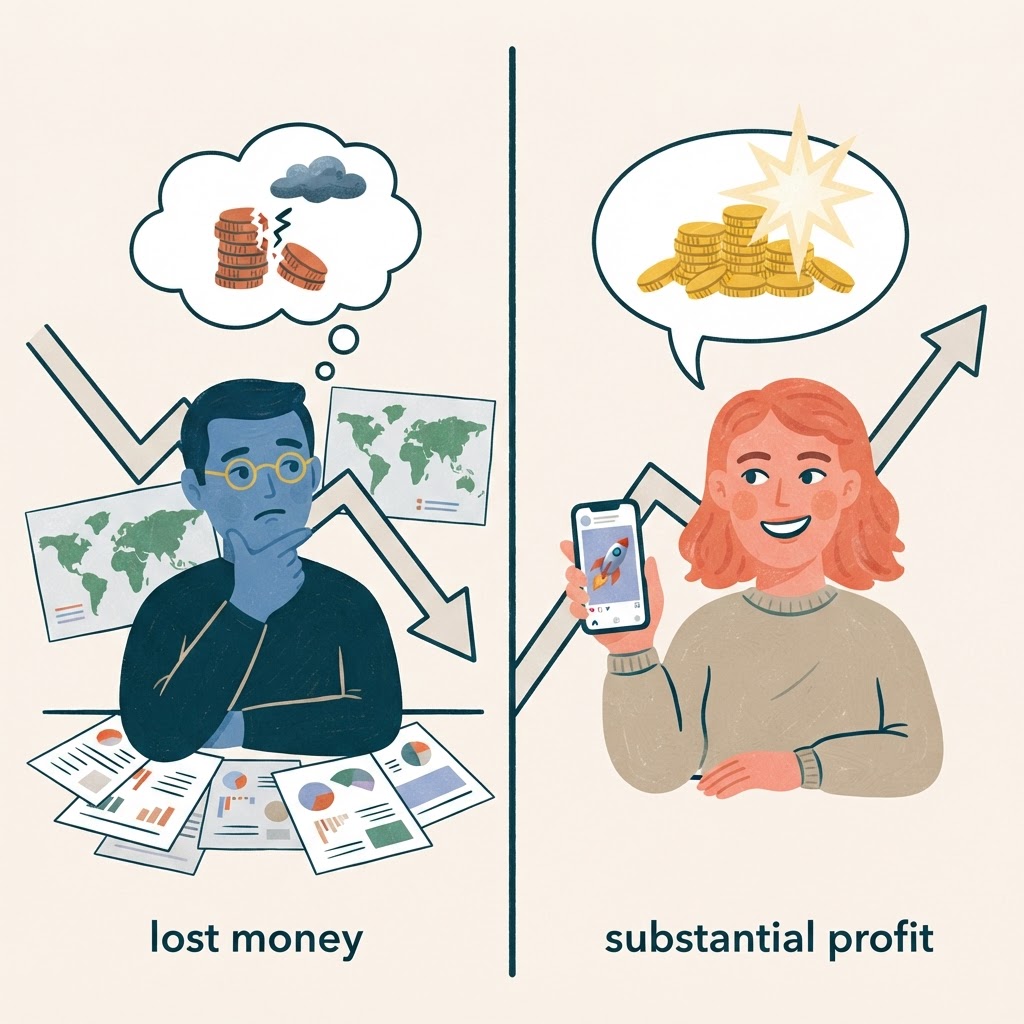
Imagine two investors making different decisions on the same day. One carefully researches the evidence, considers multiple scenarios, understands the risks, and makes a thoughtful investment. The market unexpectedly crashes the following week, and they lose money. The second investor buys a random stock based on a social media recommendation without doing any research. By pure luck, the stock surges, and they make a substantial profit.
Good decisions don't always produce good outcomes, and bad outcomes don't always mean you made the wrong choice.
Imagine two investors making different decisions on the same day. One carefully researches the evidence, considers multiple scenarios, understands the risks, and makes a thoughtful investment. The market unexpectedly crashes the following week, and they lose money. The second investor buys a random stock based on a social media recommendation without doing any research. By pure luck, the stock surges, and they make a substantial profit.
If we judged only by the outcome, we would conclude that the second investor made the better decision. That conclusion would almost certainly be wrong. One of the biggest mistakes we make is evaluating the quality of our thinking by what happened afterwards rather than by the quality of the reasoning available at the time. This tendency, known as outcome bias, makes it difficult to learn from experience because we confuse luck with judgment.1 Decision journals provide a simple but remarkably powerful solution. By recording how and why we make important decisions before we know the outcome, we create an honest record of our thinking that helps us improve every future decision.
Why Memory Is an Unreliable Teacher
Most people assume they can accurately remember why they made an important decision. Research suggests otherwise. Human memory is not a perfect recording of events. Instead, it continually reconstructs the past using our current beliefs, emotions, and knowledge.2 Once we know how something turned out, our memories often shift to make the outcome seem more predictable than it actually was.
Psychologists refer to this as hindsight bias. After an event occurs, we tend to believe that we "knew it all along," even when our original expectations were far less certain.3 This creates the illusion that we are learning from experience while quietly rewriting the evidence.
A decision journal prevents this reconstruction. By writing down your reasoning before events unfold, you preserve an accurate snapshot of what you believed, what information you had, and why you chose a particular course of action. When you revisit the decision later, you are comparing reality with your actual thinking rather than with a memory that has been unconsciously edited.
Good Decisions Are Not the Same as Good Outcomes
One of the most important lessons from behavioural science is that uncertainty is unavoidable. Every significant decision involves incomplete information. Whether choosing a career, hiring an employee, launching a business, or making an investment, we can never predict the future with complete certainty. The objective is therefore not to eliminate uncertainty but to make the highest-quality decision possible given the evidence available.
This distinction is easy to forget because outcomes are emotionally persuasive. A successful result encourages us to believe our reasoning was excellent, while an unsuccessful outcome tempts us to conclude that our thinking was flawed. The reality is more nuanced. Excellent decisions sometimes produce disappointing outcomes because of factors outside our control. Likewise, poor decisions occasionally succeed through luck alone. Decision journals help separate the quality of the decision-making process from the randomness of the outcome, allowing us to evaluate our thinking more fairly and accurately.4
What Goes Into a Decision Journal?
A decision journal is intentionally simple. Before making an important decision, record the key elements of your thinking. The goal is not to produce a lengthy report but to capture enough information that your future self can understand how the decision was made.
Useful questions include:
- What decision am I making?
- What evidence am I relying on?
- What assumptions am I making?
- What alternatives did I consider?
- What risks concern me most?
- What outcome do I expect?
- How confident am I, expressed as a percentage?
- What evidence would cause me to change my mind?
Including a confidence estimate is particularly valuable. Research by Philip Tetlock and colleagues has shown that people can improve their judgment over time by learning to calibrate confidence more accurately.5 Decision journals provide the feedback needed to develop this skill because they reveal whether confidence consistently matches reality.
The Power of Reviewing Old Decisions
Writing a decision journal is only half the process. The real learning occurs when you return to previous entries after enough time has passed for outcomes to become clear. Instead of asking simply whether the decision succeeded, examine the quality of your reasoning. Were your assumptions reasonable? Did you overlook important evidence? Were you overconfident? Did unexpected events influence the result? Most importantly, what would you do differently if faced with the same decision today?
This kind of structured reflection develops metacognition—the ability to think about your own thinking.6 Rather than repeating habits automatically, you begin recognising patterns in your judgment. Over time, these patterns become far more valuable than any individual decision because they reveal how you consistently reason under uncertainty.
AI Can Become Your Decision Coach
Artificial intelligence makes decision journals even more powerful. Instead of using AI to make decisions on your behalf, use it to strengthen the quality of your reasoning before you commit to a choice. After writing your journal entry, ask AI to challenge your assumptions.
You might ask:
- What evidence am I overlooking?
- What cognitive biases might influence my thinking?
- What would someone who disagrees with me argue?
- What are the strongest arguments against this decision?
- What scenarios have I failed to consider?
After the outcome becomes known, ask AI to compare your original reasoning with what actually happened. It can help identify recurring patterns such as overconfidence, confirmation bias, or consistently underestimating uncertainty. In this way, AI becomes a thinking partner rather than a decision-maker. It improves your judgment without removing your responsibility to make the final choice.
Small Habit, Lasting Benefits
Decision journals are valuable because they create a feedback loop that most people never experience. Without a written record, we naturally remember our successful predictions more clearly than our mistakes. We forget assumptions that proved incorrect, reinterpret our reasoning after the fact, and gradually become overconfident in our judgment.
A decision journal interrupts this process. It creates accountability to your own thinking while providing the evidence needed for continuous improvement. Over months and years, these records reveal recurring strengths and weaknesses that would otherwise remain invisible. Many successful investors, military leaders, entrepreneurs, and professional forecasters rely on some version of this habit because they understand that better decisions emerge from better reflection rather than better memory.7
Better Decisions Through Better Thinking
Life rarely rewards certainty. Instead, it rewards people who can make thoughtful decisions despite uncertainty, learn from experience without distorting it, and continually refine their judgment over time. Decision journals support exactly this process. They encourage us to evaluate decisions according to the quality of our reasoning rather than the randomness of outcomes. They help us distinguish luck from skill, recognise recurring biases, and become more intellectually honest about how we think.
This habit aligns naturally with cognitive fitness. Strong thinkers are not defined by never making mistakes. They are defined by their willingness to examine those mistakes carefully, learn from them, and make better decisions in the future. Artificial intelligence can provide faster information than ever before, but it cannot replace thoughtful judgment. Decision journals ensure that every important choice becomes an opportunity to strengthen that judgment, making each decision not just an outcome to evaluate, but an investment in becoming a better thinker.
Try This
Before making your next important decision, create a one-page journal entry. Record:
- The decision you're making.
- The evidence supporting it.
- Your key assumptions.
- The alternatives you considered.
- Your confidence level (0–100%).
- The factors that would change your mind.
After the outcome is known, review your entry with AI. Ask it to identify where your reasoning was strong, where you were overconfident, and what lessons you can apply to future decisions.
Key Takeaways
- Good decisions should be judged by the quality of the reasoning, not simply by the outcome.
- Hindsight bias makes memory an unreliable guide for learning from experience.
- Decision journals preserve your original thinking before outcomes influence your recollection.
- Reviewing previous decisions develops metacognition and improves long-term judgment.
- AI is most valuable when it challenges your reasoning before and after important decisions rather than making the decisions for you.
Continue the Conversation
The AI Thinking Partner Playbook introduces seven practical frameworks for using AI to strengthen—not replace—your thinking. The Cognitive Coach and Scenario Builder frameworks help you reflect on your decisions, challenge your assumptions, and learn systematically from experience. Download your free copy and begin developing the cognitive fitness needed to make better decisions in the age of AI.
References
-
Baron, J. Thinking and Deciding. 4th edn. Cambridge: Cambridge University Press (2008).
-
Schacter, D.L. The Seven Sins of Memory: How the Mind Forgets and Remembers. Boston: Houghton Mifflin (2001).
-
Fischhoff, B. Hindsight ≠ foresight: The effect of outcome knowledge on judgment under uncertainty. Journal of Experimental Psychology: Human Perception and Performance 1, 288–299 (1975).
-
Kahneman, D. Thinking, Fast and Slow. London: Penguin Books (2011).
-
Tetlock, P.E. & Gardner, D. Superforecasting: The Art and Science of Prediction. London: Random House (2015).
-
Flavell, J.H. Metacognition and cognitive monitoring: A new area of cognitive–developmental inquiry. American Psychologist 34, 906–911 (1979).
-
Dobelli, R. The Art of Thinking Clearly. London: Sceptre (2013).
Enjoying this article?
Get more like it delivered to your inbox once a month.