First-Principles Thinking
Imagine you are asked to improve a product, redesign a service, or solve a difficult business problem. Most people instinctively begin by looking at existing solutions. They compare competitors, borrow familiar ideas, and make incremental improvements. This approach is efficient because it builds on what already exists, but it also has limitations. If everyone starts with the same assumptions, everyone tends to arrive at similar answers.
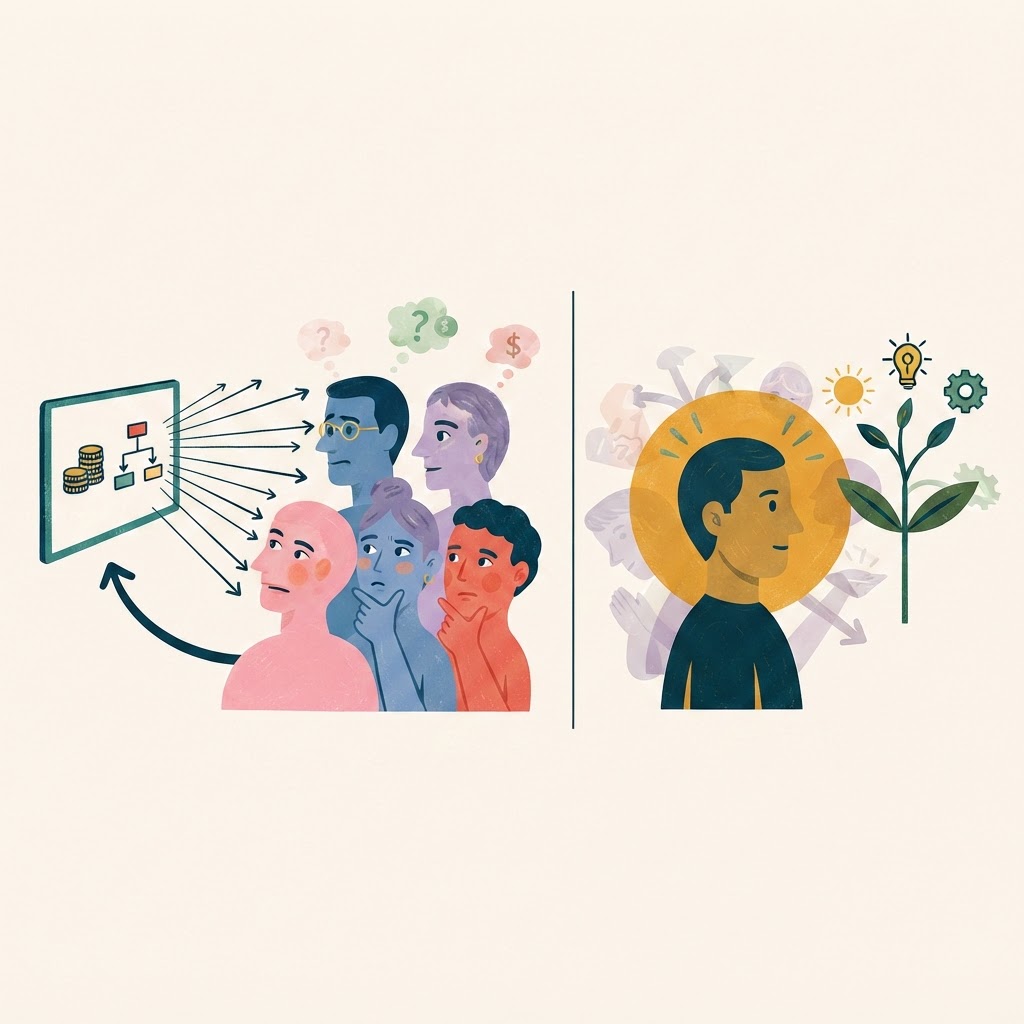
The best solutions rarely come from asking, "How has this always been done?" They begin by asking, "What is fundamentally true?"
Imagine you are asked to improve a product, redesign a service, or solve a difficult business problem. Most people instinctively begin by looking at existing solutions. They compare competitors, borrow familiar ideas, and make incremental improvements. This approach is efficient because it builds on what already exists, but it also has limitations. If everyone starts with the same assumptions, everyone tends to arrive at similar answers.
Some of the world's most significant breakthroughs have emerged from a different approach. Rather than reasoning by analogy—copying or adapting what already exists—great thinkers have often stripped problems back to their most fundamental truths before rebuilding solutions from the ground up. This approach is known as first-principles thinking, and it has shaped discoveries in science, engineering, philosophy, and innovation for centuries.1
In a world where AI can instantly generate ideas based on existing patterns, first-principles thinking is becoming an increasingly valuable human capability. While AI excels at identifying similarities across enormous amounts of information, people remain uniquely responsible for questioning assumptions, redefining problems, and imagining entirely new possibilities.
Reasoning by Analogy Versus Reasoning from First Principles
Most of our everyday thinking relies on analogy. When we encounter a new problem, we naturally search for something similar that we have seen before. If a colleague solved a comparable challenge, we adapt their approach. If a competitor has a successful product, we borrow elements of its design. If a familiar process has worked in the past, we assume it will probably work again. This form of reasoning is both practical and efficient. Human cognition depends on recognising patterns because doing so allows us to make decisions quickly without analysing every situation from scratch. In many cases, analogy is exactly the right approach. Problems arise when assumptions embedded within those analogies are no longer valid. If we continue solving today's problems using yesterday's models, innovation becomes incremental rather than transformative. First-principles thinking encourages us to pause before accepting inherited assumptions and ask whether they are actually true or simply familiar.
What Are First Principles?
The idea of first principles can be traced back to Aristotle, who described them as the foundational truths from which knowledge is built.2 Rather than accepting conclusions at face value, he argued that understanding begins by identifying the most basic facts that cannot reasonably be reduced any further. In practical terms, first-principles thinking involves breaking a problem into its essential components before reconstructing it from the ground up. Imagine someone says, "Electric vehicles are too expensive." Reasoning by analogy might focus on making current manufacturing processes slightly cheaper.
First-principles thinking asks a different set of questions. Why are they expensive? Which components contribute most to the cost? Are those costs determined by physics, engineering, supply chains, or historical manufacturing practices? Which assumptions are fixed, and which could change? By separating facts from assumptions, entirely new possibilities become visible. This approach has been popularised in recent years through entrepreneurs such as Muhammad Yunus, who used first-principles reasoning to rethink the fundamentals of lending rather than accepting that banks must require collateral and that the poor are not creditworthy, leading to the creation of Grameen Bank and the microcredit movement.3 Although contemporary business discussions often associate the concept with innovation, its intellectual roots extend much further into philosophy and scientific reasoning.
Why the Brain Prefers Assumptions
If first-principles thinking is so valuable, why do we not use it more often? The answer lies partly in how the brain conserves effort. Human cognition relies heavily on mental shortcuts, or heuristics, because analysing every situation from first principles would be mentally exhausting. Psychologist Daniel Kahneman describes this as the distinction between fast, intuitive thinking and slower, more deliberate reasoning.4 Fast thinking allows us to navigate everyday life efficiently, while slower thinking enables us to question assumptions and evaluate unfamiliar situations more carefully.
Most of the time, heuristics work remarkably well. The challenge is that they also encourage us to inherit assumptions without examining them. We often accept existing definitions of problems, established ways of working, or conventional wisdom simply because they are familiar. First-principles thinking deliberately interrupts this process by asking us to identify which beliefs are evidence-based and which are merely inherited. Rather than asking, "What is the normal way to solve this?", it asks, "What do I know with confidence, and what have I assumed?"
Scientific Thinking Begins with First Principles
Although first-principles thinking is frequently discussed in business and innovation, it is fundamentally aligned with scientific reasoning. Scientists do not begin by assuming existing explanations are correct. They formulate hypotheses, gather evidence, and revise their understanding when new evidence emerges. Progress occurs because assumptions remain open to challenge rather than becoming permanent truths.
Consider the development of modern medicine. Many accepted treatments have been abandoned after careful experimentation demonstrated that they were ineffective or even harmful. Advances occur because scientific thinking continually separates evidence from assumption. The same mindset applies outside laboratories.
A leader redesigning an organisation might question long-standing reporting structures rather than assuming they remain effective. An educator might reconsider whether traditional assessment methods actually measure meaningful learning. An individual planning a career might ask whether success requires following conventional paths or whether entirely different opportunities now exist. First-principles thinking encourages us to ask not only whether something works, but why it works.
AI Is Excellent at Patterns, but Humans Must Question Them
Artificial intelligence is exceptionally good at identifying patterns across enormous datasets. Ask AI to generate marketing ideas, draft a proposal, or summarise research, and it draws upon patterns it has learned from existing examples. This makes AI extraordinarily useful for accelerating routine work and exploring established approaches. However, genuine innovation often requires questioning the patterns themselves.
If the assumptions underlying an industry are flawed, generating more variations of existing solutions may simply reinforce outdated thinking. AI can certainly assist with analysing assumptions, but humans must first decide which assumptions deserve scrutiny. This creates a productive partnership. You might ask AI to identify common approaches to solving a problem. Then ask it to list every assumption those approaches share. Next, challenge AI to imagine what would happen if each assumption were removed.
For example:
- What if this product required no ownership?
- What if customers never visited a physical location?
- What if this process had to be completed in half the time?
- What if cost were no constraint?
- What if regulation changed completely?
These questions move beyond optimisation and toward genuine redesign. AI becomes most valuable not when it replaces first-principles thinking, but when it helps us explore its implications more rapidly.
A Practical Framework for First-Principles Thinking
Like any cognitive skill, first-principles thinking improves with practice. One useful framework involves four simple steps. First, clearly define the problem. Vague problems rarely produce insightful solutions. Be specific about what you are actually trying to achieve. Second, identify your assumptions. Ask yourself what you are accepting as true without evidence. Separate facts from habits, traditions, and conventions. Third, identify the underlying principles. What constraints are genuinely fixed? Which are determined by physical laws, human needs, economics, or evidence rather than custom? Finally, rebuild the solution from those principles rather than from existing examples. This often produces ideas that initially seem unconventional because they are no longer constrained by inherited assumptions. The goal is not to reject conventional wisdom automatically. Rather, it is to ensure that accepted practices continue to deserve acceptance.
Better Thinking Begins Beneath the Surface
Many problems persist because we address symptoms instead of causes. First-principles thinking encourages us to dig beneath surface explanations until we reach the underlying mechanisms that shape a problem. Once those mechanisms become clear, solutions that once appeared impossible often become achievable. This habit is closely connected to cognitive fitness. Strong thinkers do not simply accumulate more knowledge. They become increasingly skilled at examining assumptions, clarifying concepts, and reconstructing ideas from evidence rather than convention. These abilities make them more adaptable because they are not limited to repeating familiar solutions.
Artificial intelligence will continue making pattern recognition faster than ever before. That makes first-principles thinking even more valuable. The future will not belong solely to those who generate ideas quickly. It will belong to those who understand problems deeply enough to question the assumptions everyone else takes for granted.
Try This
Choose a problem you are currently trying to solve. Instead of asking AI for an immediate solution, begin with these questions:
- What assumptions am I making about this problem?
- Which of those assumptions are supported by evidence?
- What are the fundamental principles involved?
- If I started from those principles alone, how might I design a completely different solution?
Then ask AI to challenge your assumptions and suggest alternative ways of rebuilding the problem from first principles.
Key Takeaways
- First-principles thinking solves problems by reasoning from fundamental truths rather than existing examples.
- Most everyday thinking relies on analogy, which is efficient but can reinforce outdated assumptions.
- Innovation often begins by separating evidence from convention and questioning inherited beliefs.
- AI is excellent at recognising patterns but depends on humans to identify which assumptions deserve reconsideration.
- Developing first-principles thinking strengthens cognitive fitness by encouraging deeper reasoning and more adaptable problem-solving.
Continue the Conversation
The AI Thinking Partner Playbook introduces seven practical frameworks for using AI to strengthen—not replace—your thinking. The First-Principles Co-pilot framework helps you use AI to challenge assumptions, uncover root causes, and explore solutions built on evidence rather than convention. Download your free copy and begin developing the cognitive fitness needed to think more independently in the age of AI.
References
-
Simon, H.A. The Sciences of the Artificial. 3rd edn. Cambridge, MA: MIT Press (1996).
-
Aristotle. Metaphysics. Translated by W.D. Ross. In: The Complete Works of Aristotle. Princeton, NJ: Princeton University Press (1984).
-
Yunus, M. Banker to the Poor: Micro-Lending and the Battle Against World Poverty. New York: PublicAffairs (1999).
-
Kahneman, D. Thinking, Fast and Slow. London: Penguin Books (2011).
-
Meadows, D.H. Thinking in Systems: A Primer. White River Junction, VT: Chelsea Green Publishing (2008).
-
Senge, P.M. The Fifth Discipline: The Art and Practice of the Learning Organization. New York: Doubleday (1990).
-
Chi, M.T.H., Feltovich, P.J. & Glaser, R. Categorization and representation of physics problems by experts and novices. Cognitive Science 5, 121–152 (1981).
Enjoying this article?
Get more like it delivered to your inbox once a month.