What Is Cognitive Offloading?
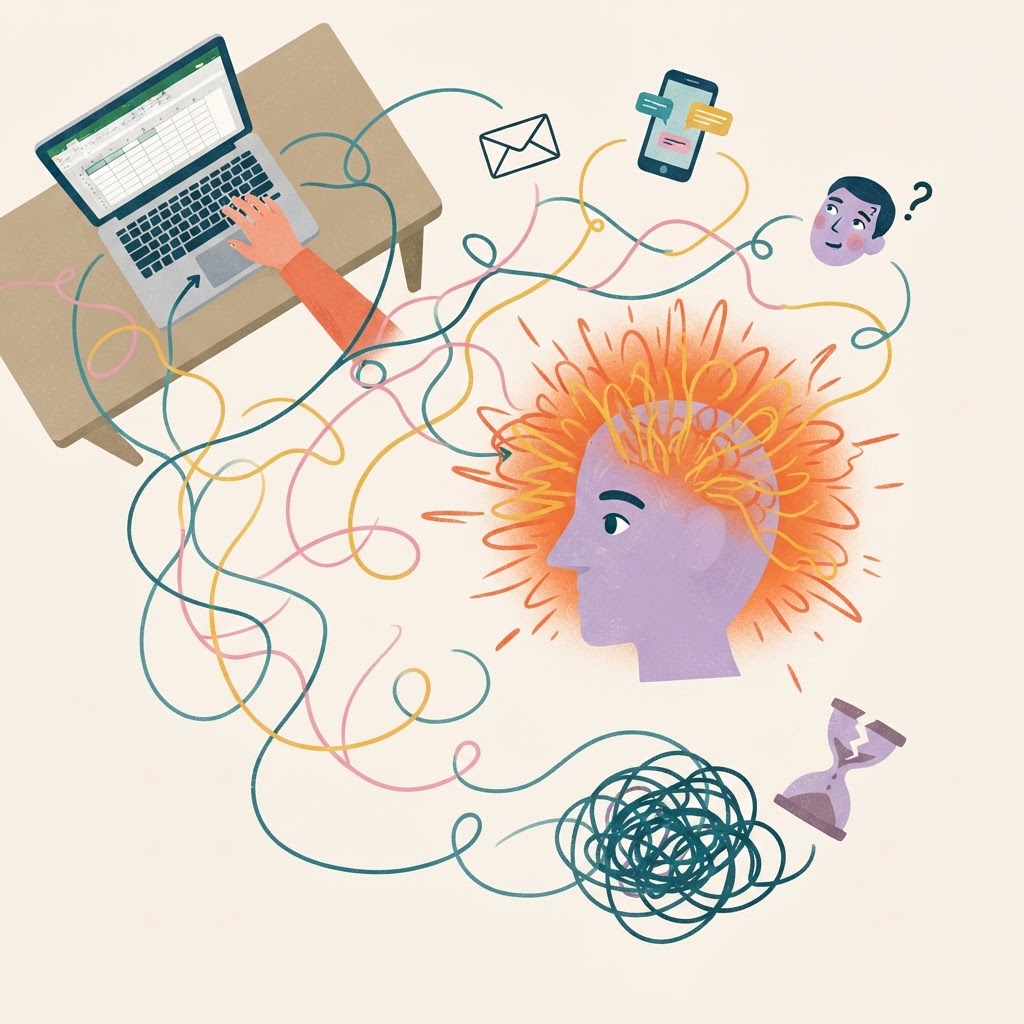
Imagine trying to remember every phone number you know without using your contacts app. Picture navigating an unfamiliar city without GPS or performing complex calculations without a calculator. Most of us rarely do these things because technology has become remarkably good at handling them for us.

When does using technology make us more capable—and when does it quietly begin doing our thinking for us?
Imagine trying to remember every phone number you know without using your contacts app. Picture navigating an unfamiliar city without GPS or performing complex calculations without a calculator. Most of us rarely do these things because technology has become remarkably good at handling them for us.
This is not necessarily a problem.
In fact, relying on external tools to reduce mental effort is a normal and often beneficial part of human cognition. Psychologists call this cognitive offloading: the use of physical actions or external resources to reduce the demands placed on our memory, attention, or problem-solving abilities.1
Far from being a modern phenomenon, cognitive offloading has been part of human life for thousands of years. We write shopping lists, keep calendars, draw diagrams, take notes, and leave reminders for ourselves because doing so frees our minds to focus on more important tasks.
Artificial intelligence represents the newest—and perhaps most powerful—form of cognitive offloading. Like every transformative technology before it, it offers enormous benefits. It also raises an important question: which kinds of thinking should we delegate, and which should we continue doing ourselves?
The Brain Was Never Meant to Do Everything
There is a common misconception that intelligent people remember everything.
In reality, experts often rely heavily on external systems. Scientists keep laboratory notebooks. Architects sketch ideas. Writers fill journals with observations. Surgeons use checklists. Pilots follow standard operating procedures.
These tools do not compensate for a lack of intelligence. They allow experts to direct their mental energy toward the aspects of their work that require creativity, judgment, and decision-making.
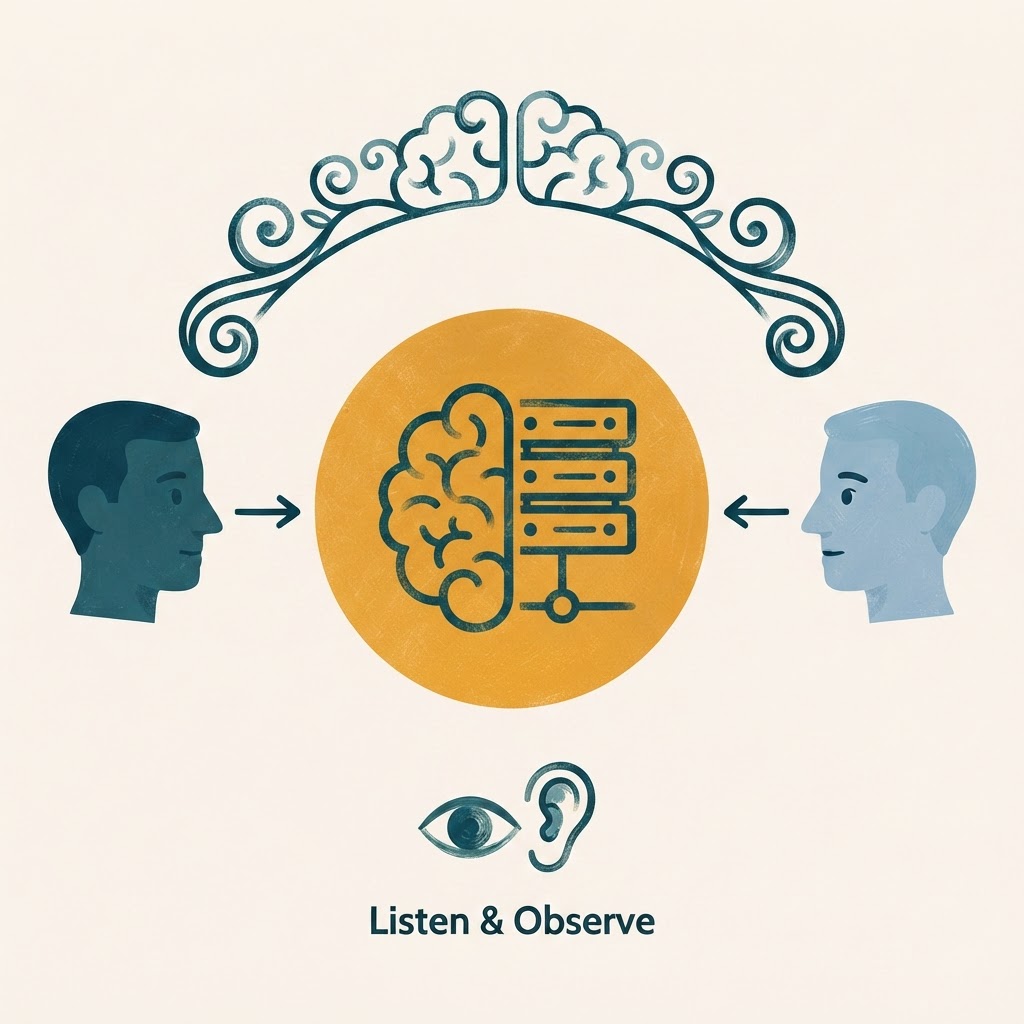
Cognitive scientists increasingly describe human thinking as extending beyond the boundaries of the brain itself. In their influential paper The Extended Mind, philosophers Andy Clark and David Chalmers argued that external tools can become meaningful parts of our cognitive system when they reliably support thinking.2 A notebook, for example, is not simply a storage device. When used regularly, it becomes part of how we remember and reason.
Seen this way, cognitive offloading is not evidence of weaker thinking. It is one of the reasons humans have been able to build civilizations, conduct science, and solve increasingly complex problems.
The challenge is deciding what we should offload.
Helpful Offloading Versus Harmful Offloading
Not all forms of cognitive offloading are equally beneficial.
Using GPS to navigate an unfamiliar city allows you to focus on driving safely rather than memorizing every street. Using a calculator reduces arithmetic errors during engineering calculations. Keeping a calendar prevents forgotten appointments.
These tools reduce routine cognitive demands while preserving our capacity for higher-order thinking.
Artificial intelligence, however, can offload much more than routine tasks.
It can generate essays, summarize books, formulate arguments, produce strategic plans, write computer code, brainstorm ideas, and even recommend decisions. These activities are fundamentally different because they involve the very cognitive processes through which we learn.
When AI performs these tasks without our meaningful participation, we risk outsourcing opportunities to strengthen reasoning, creativity, and understanding.
The concern is not that AI makes people less intelligent overnight. Rather, it may gradually reduce the frequency with which we engage in the mental effort required to develop expertise.
Just as physical fitness declines when muscles are rarely challenged, cognitive capabilities may weaken if they are consistently bypassed.
Learning Requires Mental Effort
One of the most consistent findings in learning science is that effortful learning often produces stronger long-term understanding than effortless learning.
Researchers describe these productive challenges as desirable difficulties.3 Activities such as retrieving information from memory, solving problems before seeing solutions, and explaining concepts in your own words require more effort in the moment, but they produce more durable learning.
By contrast, passive review often creates an illusion of understanding without producing lasting knowledge.
Artificial intelligence has the potential to reduce many desirable difficulties.
Suppose a student asks AI to summarize every textbook chapter before reading it. The summaries may be accurate and efficient, but the student loses opportunities to wrestle with unfamiliar ideas, identify misconceptions, and construct understanding independently.
The same principle applies in professional settings. If AI drafts every report, generates every strategy, and formulates every argument, individuals may complete more work while developing fewer of the thinking skills that distinguish expert performance.
Efficiency and learning are not always the same goal.
Sometimes the struggle is precisely what makes growth possible.
AI Can Strengthen Thinking Too
Recognizing the risks of cognitive offloading does not mean we should avoid AI.
In fact, AI can become one of the most effective tools ever created for developing better thinking—provided we use it differently.
Instead of asking AI to produce finished work immediately, we can invite it into the thinking process.
It can ask probing questions before offering answers.
It can identify assumptions we may have overlooked.
It can challenge weak arguments.
It can present alternative perspectives.
It can simulate debates.
It can quiz us before explaining difficult concepts.
It can provide feedback on our reasoning instead of replacing it.
These interactions preserve the mental effort that supports learning while still benefiting from AI's remarkable capabilities.
The distinction is subtle but important. One approach uses AI to avoid thinking. The other uses AI to improve thinking.
Becoming Intentional About Offloading
Most people do not consciously decide when to offload cognitive work. They simply choose the fastest available option.
Intentional AI use begins by asking a different question.
Rather than asking, "Can AI do this for me?", ask, "Would doing this myself strengthen an ability I want to develop?"
If the task involves repetitive formatting, routine calculations, transcription, or information retrieval, offloading may be entirely appropriate.
If the task involves reasoning, learning, creativity, judgment, or reflection, maintaining an active role is usually worth the additional effort.
This does not mean refusing assistance. It means designing interactions that keep your mind engaged.
One useful habit is to delay automation until after making your own initial attempt. Form your own explanation before asking AI to critique it. Brainstorm your own ideas before requesting alternatives. Solve part of a problem before seeking guidance.
By contributing first, you preserve the learning opportunities that cognitive offloading can otherwise eliminate.
Cognitive Fitness Depends on What You Practise
Every interaction with technology shapes your habits of mind.
Over time, these habits accumulate.
If AI consistently performs your higher-order thinking, you become increasingly skilled at delegating cognition.
If AI consistently challenges, questions, and refines your thinking, you become increasingly skilled at thinking itself.
Neither outcome is inevitable.
The difference lies not in the technology, but in the choices we make each time we use it.
Cognitive offloading is one of humanity's greatest strengths. It has allowed us to extend memory, coordinate knowledge across generations, and solve problems far beyond the limits of individual minds. Artificial intelligence is the latest chapter in that story.
The opportunity now is to ensure that AI extends human intelligence without quietly replacing the mental habits that make intelligence possible in the first place.
Try This
The next time you ask AI for help, pause before submitting your prompt.
Ask yourself:
- What part of this task genuinely benefits from automation?
- What part would help me grow if I did it myself?
- How could I ask AI to coach my thinking instead of replacing it?
Then rewrite your prompt so that AI becomes a collaborator rather than an autopilot.
Key Takeaways
- Cognitive offloading is the use of external tools to reduce mental effort.
- Humans have always offloaded cognition through notebooks, calendars, diagrams, and other technologies.
- AI extends cognitive offloading into higher-order thinking tasks such as reasoning, writing, and decision-making.
- Learning depends on engaging in mental effort, particularly when developing expertise.
- The most effective use of AI preserves opportunities to think while providing guidance, feedback, and constructive challenge.
Continue the Conversation
The AI Thinking Partner Playbook introduces seven practical frameworks for using AI as a thinking partner rather than an intellectual shortcut. Learn how to strengthen your reasoning, ask better questions, and build lasting cognitive fitness with AI by your side—not in your place.
References
-
Risko, E.F. & Gilbert, S.J. Cognitive offloading. Trends in Cognitive Sciences 20, 676–688 (2016).
-
Clark, A. & Chalmers, D. The extended mind. Analysis 58, 7–19 (1998).
-
Bjork, R.A. & Bjork, E.L. Making things hard on yourself, but in a good way: Creating desirable difficulties to enhance learning. In: Gernsbacher, M.A., Pew, R.W., Hough, L.M. & Pomerantz, J.R. (eds.) Psychology and the Real World: Essays Illustrating Fundamental Contributions to Society. New York: Worth Publishers, pp. 56–64 (2011).
-
Brown, P.C., Roediger III, H.L. & McDaniel, M.A. Make It Stick: The Science of Successful Learning. Cambridge, MA: Harvard University Press (2014).
-
Roediger III, H.L. & Karpicke, J.D. Test-enhanced learning: Taking memory tests improves long-term retention. Psychological Science 17, 249–255 (2006).
-
Clark, A. The Experience Machine: How Our Minds Predict and Shape Reality. New York: Pantheon Books (2023).
-
Mollick, E. Co-Intelligence: Living and Working with AI. New York: Portfolio (2024).
Enjoying this article?
Get more like it delivered to your inbox once a month.