Designing Better Habits
Most people have experienced the same cycle. A new year begins, and we commit to exercising regularly, reading more books, eating healthier meals, or spending less time on our phones. For a few days—or perhaps a few weeks—everything goes well. Then life becomes busy. Motivation fades. Old routines quietly return, and we conclude that we simply lack discipline.
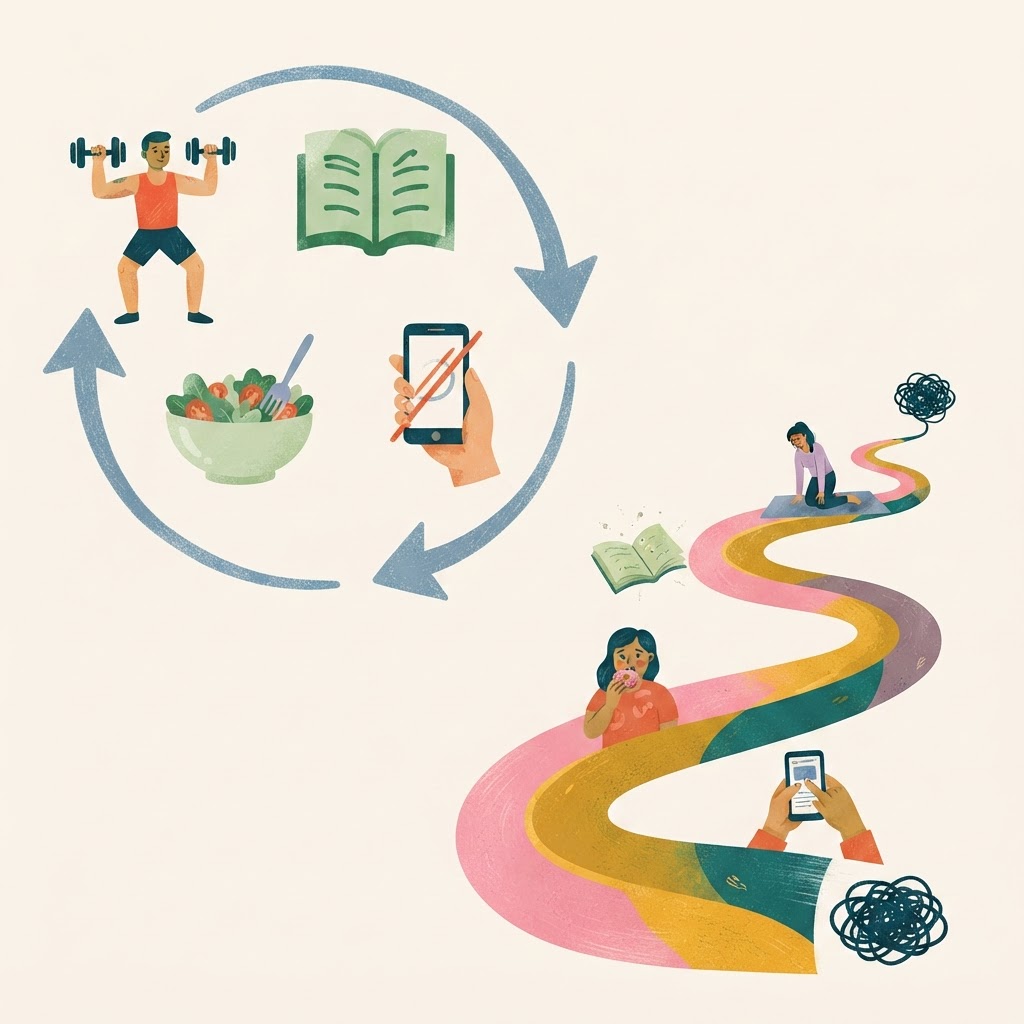
Lasting change rarely comes from motivation. It comes from designing environments and routines that make good behaviour easier than bad behaviour.
Most people have experienced the same cycle. A new year begins, and we commit to exercising regularly, reading more books, eating healthier meals, or spending less time on our phones. For a few days—or perhaps a few weeks—everything goes well. Then life becomes busy. Motivation fades. Old routines quietly return, and we conclude that we simply lack discipline.
The problem, however, is often not motivation. Behavioural science suggests that our actions are shaped far more by our environment, routines, and repeated cues than by willpower alone.1 People who consistently maintain healthy habits are not necessarily more motivated than everyone else. Instead, they have often designed systems that make desirable behaviours easier, more automatic, and more rewarding.
In the age of AI, this insight becomes even more valuable. Artificial intelligence can help us build better habits, but only if we use it to strengthen our routines rather than replace our effort. Sustainable improvement comes from designing systems that support good thinking and consistent action over time.
Habits Are the Brain's Energy-Saving System
The human brain is remarkably efficient. Every conscious decision requires mental effort, and because cognitive resources are limited, the brain constantly looks for opportunities to automate repeated behaviours. Habits allow us to perform everyday activities with minimal conscious attention, freeing our minds to focus on more demanding tasks.2
Imagine driving to work along a familiar route. Much of the journey happens almost automatically because your brain has repeated the sequence hundreds of times before. The same principle applies to brushing your teeth, preparing coffee, checking your email, or locking your front door.
This automaticity is neither good nor bad. The same mechanism that makes healthy routines effortless can also reinforce behaviours that no longer serve us. Whether habits improve or diminish our lives depends largely on which behaviours become automatic.
Small Changes Become Big Results
Many people overestimate the importance of dramatic change while underestimating the power of small improvements. Research into behaviour change shows that consistent repetition matters far more than occasional bursts of motivation.3 Reading ten pages every day may not seem significant, but over the course of a year it becomes several books. Walking for twenty minutes each day may appear modest, yet it produces meaningful improvements in health, mood, and cognitive function over time.
Habits work because they compound. Each individual action may appear insignificant, but repeated consistently, those actions gradually reshape knowledge, skills, health, relationships, and identity. Just as compound interest transforms small financial investments into substantial wealth, repeated behaviours accumulate into lasting personal change.
The challenge is recognising that progress is often invisible in the short term. Habits rarely produce immediate transformation, but they quietly determine where we arrive months and years later.
Environment Often Beats Willpower
When people struggle to maintain good habits, they often blame themselves. Behavioural research suggests we should first examine our environment. Our surroundings constantly influence behaviour through cues that trigger automatic responses.4 A bowl of fruit on the kitchen counter encourages healthier eating than biscuits left within easy reach. A book placed beside the bed is more likely to be read than one hidden on a shelf. A phone left on the desk invites distraction even when notifications are disabled.
Small environmental changes reduce the amount of self-control required. Rather than relying on willpower to avoid distractions, strong habit design removes unnecessary temptation altogether. Instead of expecting ourselves to remember important behaviours, we create visible reminders that make those behaviours easier to begin.
The most effective habits often succeed because they require less discipline, not more.
Identity Shapes Behaviour
Many people approach habits by focusing on outcomes. They aim to lose weight, learn a language, write a book, or exercise regularly. While these goals provide direction, they do not necessarily create lasting change.
Psychologists have found that behaviour is strongly influenced by identity—the stories we tell ourselves about who we are.5 Someone who believes, "I'm trying to write," behaves differently from someone who believes, "I'm a writer." The first focuses on achieving an outcome. The second reinforces an identity through repeated action.
Every habit therefore becomes evidence. Each time you read, you reinforce the identity of someone who values learning. Each thoughtful conversation strengthens the identity of someone who values curiosity. Every reflective journal entry reinforces the identity of someone committed to better thinking. Over time, these repeated actions become part of how we see ourselves, making future behaviours easier to sustain.
Habits for Better Thinking
When people think about habits, they often focus on physical health. Equally important are the habits that shape our thinking. Strong thinkers rarely depend on occasional inspiration. Instead, they develop routines that consistently support learning, reflection, and sound judgment. They ask thoughtful questions, review important decisions, read widely, write regularly, seek opposing viewpoints, and reflect on what they have learned. These habits strengthen cognitive fitness because they repeatedly exercise the mental skills that underpin good reasoning.
For example, spending ten minutes each evening reflecting on the day's decisions gradually improves metacognition. Reading a research article every morning strengthens curiosity. Writing a brief summary after finishing a book reinforces understanding through retrieval and explanation. None of these activities is dramatic on its own. Together, they gradually transform the way we think.
AI Can Help Build Better Habits
Artificial intelligence is particularly valuable when it supports consistency rather than replacing effort. Instead of asking AI to complete tasks for you, ask it to help design routines that encourage better behaviour. For example, AI can remind you to reflect on important decisions, generate thoughtful journal prompts, quiz you using retrieval practice, recommend progressively challenging learning activities, or help review your weekly goals. It can also identify patterns in your behaviour that you may not have noticed yourself.
Imagine ending each day by asking AI:
"Help me reflect on today's decisions. What patterns do you notice? Which habits supported good thinking, and which habits distracted me?"
Over time, these conversations create a continuous feedback loop that strengthens self-awareness. In this role, AI becomes a cognitive coach rather than a productivity shortcut.
Design Systems, Not Resolutions
The most successful people rarely depend on motivation alone. They create systems that make good decisions easier, poor decisions harder, and continuous improvement almost inevitable. They recognise that habits emerge from thoughtful design rather than repeated acts of self-control.
This mindset shifts the focus away from dramatic transformation and towards steady progress. Instead of asking, "How can I become a different person?", ask, "What small behaviour can I repeat consistently?" Instead of pursuing perfection, pursue repetition. Instead of waiting to feel motivated, design an environment where the desired behaviour becomes the easiest option.
This philosophy sits at the heart of cognitive fitness. Strong thinking is not built through occasional breakthroughs. It develops through hundreds of small moments of curiosity, reflection, learning, and deliberate practice. Every thoughtful question, every page read, every decision reviewed, and every habit repeated becomes another investment in a stronger mind.
Artificial intelligence can accelerate this journey, but it cannot build the habits for us. Lasting improvement still comes from showing up consistently, designing environments that support our goals, and recognising that the smallest daily actions often produce the greatest long-term results.
Try This
Choose one thinking habit you would like to develop over the next month. It might be:
- Writing for ten minutes each morning.
- Reading one research article each week.
- Reflecting on one important decision every evening.
- Asking AI to challenge one assumption each day.
- Summarising everything you learn in your own words.
Then ask AI:
Help me design a simple system that makes this habit easy to begin and easy to repeat. Identify likely obstacles, suggest environmental changes, and help me review my progress once a week.
Focus on consistency rather than perfection.
Key Takeaways
- Habits reduce cognitive effort by automating repeated behaviours.
- Small actions compound into significant long-term improvements.
- Environment often influences behaviour more powerfully than motivation alone.
- Identity-based habits create lasting change by reinforcing who we believe we are.
- AI is most valuable when it supports consistent reflection, learning, and cognitive fitness rather than replacing effort.
Continue the Conversation
The AI Thinking Partner Playbook introduces seven practical frameworks for using AI to strengthen—not replace—your thinking. The Cognitive Coach framework helps you design habits that encourage reflection, deliberate learning, and continuous improvement while using AI as a partner in building lasting cognitive fitness. Download your free copy and begin creating the daily habits that will strengthen your thinking for years to come.
References
-
Wood, W. Good Habits, Bad Habits: The Science of Making Positive Changes That Stick. New York: Farrar, Straus and Giroux (2019).
-
Wood, W. & Rünger, D. Psychology of habit. Annual Review of Psychology 67, 289–314 (2016).
-
Lally, P., van Jaarsveld, C.H.M., Potts, H.W.W. & Wardle, J. How are habits formed? Modelling habit formation in the real world. European Journal of Social Psychology 40, 998–1009 (2010).
-
Thaler, R.H. & Sunstein, C.R. Nudge: Improving Decisions About Health, Wealth, and Happiness. Revised edn. London: Penguin Books (2021).
-
Dweck, C.S. Mindset: The New Psychology of Success. Updated edn. New York: Ballantine Books (2016).
-
Clear, J. Atomic Habits: Tiny Changes, Remarkable Results. London: Random House Business (2018).
-
Duckworth, A. Grit: The Power of Passion and Perseverance. London: Vermilion (2016).
Enjoying this article?
Get more like it delivered to your inbox once a month.