Attention Is Your Greatest Asset
Every day, your attention is pulled in dozens of different directions. Emails arrive before you've finished your morning coffee. Notifications interrupt conversations. Social media competes with work, while news headlines compete with books, podcasts, and the quiet moments needed for reflection. Even when we intend to focus, the temptation to check one more message or search one more answer is never far away.
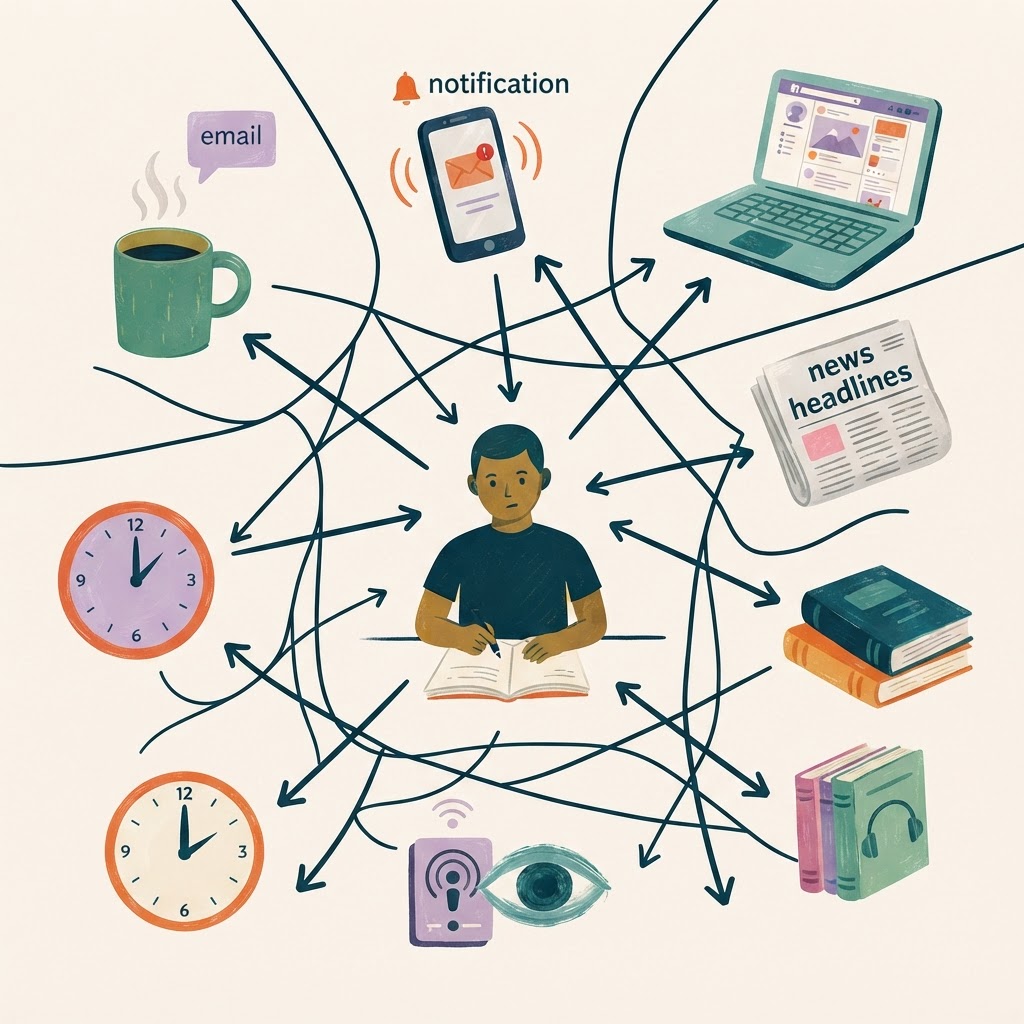
In an age of unlimited information, your ability to direct your attention may matter more than your ability to access knowledge.
Every day, your attention is pulled in dozens of different directions. Emails arrive before you've finished your morning coffee. Notifications interrupt conversations. Social media competes with work, while news headlines compete with books, podcasts, and the quiet moments needed for reflection. Even when we intend to focus, the temptation to check one more message or search one more answer is never far away.
It is easy to think that information overload is the problem.
In reality, information has never been more abundant. The scarce resource is attention.
Economist Herbert Simon recognised this decades before the internet became part of everyday life. He observed that a wealth of information creates a poverty of attention because every new piece of information competes for a limited cognitive resource.1 Today, with artificial intelligence making information even more accessible, Simon's insight has become increasingly relevant. Success depends less on finding information and more on deciding what deserves our attention in the first place.
Attention Is the Gateway to Thinking
Attention is often described as the brain's filtering system. Every second, our senses receive far more information than the brain can consciously process. Attention determines which information enters conscious awareness and which information is ignored. Without attention, perception becomes fragmented, memory weakens, and learning becomes significantly more difficult.2
This makes attention more than a productivity skill. It is the foundation upon which almost every other cognitive ability depends. Reasoning, creativity, problem-solving, decision-making, and memory all require sustained attention before they can occur.
Imagine trying to read a complex article while checking your phone every few minutes. Although your eyes move across the page, your understanding becomes shallow because your attention is repeatedly interrupted. The challenge is not reading faster. It is maintaining enough attention for meaningful thinking to occur.
The Cost of Constant Switching
Many people believe they are good at multitasking. Research consistently suggests otherwise. What we call multitasking is usually task switching—rapidly shifting attention between different activities rather than performing them simultaneously.3 Each switch carries a cognitive cost because the brain must disengage from one task before reorienting itself to another.
These costs may seem small, but they accumulate throughout the day. Frequent interruptions increase errors, reduce comprehension, slow problem-solving, and make it more difficult to retain information. Even brief distractions can leave what psychologists call an attention residue, where part of our attention remains focused on the previous task instead of the current one.4
This explains why complex work often feels mentally exhausting despite involving relatively little physical effort. The fatigue comes not only from thinking but from repeatedly reconstructing our focus after each interruption.
Deep Attention Produces Deep Learning
Some of our most valuable thinking occurs when attention remains focused for extended periods. Psychologist Mihaly Csikszentmihalyi described this state as flow, where complete absorption in a meaningful activity leads to heightened concentration, intrinsic motivation, and high-quality performance.5 During flow, distractions fade into the background because attention becomes fully aligned with the task at hand.
Deep learning depends on similar conditions. When we remain focused long enough to connect ideas, question assumptions, and reflect on what we are learning, knowledge becomes more durable and more flexible. By contrast, fragmented attention often produces fragmented understanding. We may remember isolated facts without developing the richer mental models needed for reasoning and creativity. Attention therefore influences not only how much we learn but also the quality of our understanding.
Attention Is Becoming a Competitive Advantage
Artificial intelligence has dramatically reduced the time required to access information. Need a summary of a report? AI can produce one in seconds. Want an explanation of a complex concept? AI can provide it almost instantly. This convenience is valuable, but it also changes where human value increasingly lies.
When information becomes abundant, the ability to focus on the right information becomes increasingly important. People who can sustain attention, think deeply, and resist constant distraction are better positioned to evaluate evidence, solve complex problems, and generate original ideas. They are also more likely to recognise subtle connections that are easily missed during fragmented thinking.
In this sense, attention is becoming a competitive advantage. It allows us to do something AI cannot fully replicate: devote sustained human judgment to questions that require wisdom rather than speed.
AI Can Protect or Consume Your Attention
Artificial intelligence presents an interesting paradox. Used carelessly, AI can become another source of distraction. Endless conversations, rapid-fire prompts, and constant curiosity can encourage shallow engagement with many topics instead of deep engagement with a few meaningful ones. Used intentionally, however, AI can protect attention rather than fragment it.
Imagine beginning your day by asking AI to summarise overnight industry news instead of spending thirty minutes scanning multiple websites. Ask it to organise research into themes before you begin reading. Use it to identify the most important questions within a complex report or to remove repetitive administrative work that consumes valuable mental energy.
In each of these examples, AI is not replacing your thinking. It is protecting your attention so that your thinking can be directed where it matters most. The goal is not to spend more time with AI. The goal is to spend more of your best attention on work that genuinely requires human reasoning.
Designing an Environment for Attention
Attention is influenced as much by our environment as by our intentions. Many people believe they struggle to focus because they lack discipline. In reality, our surroundings constantly shape where attention goes. Notifications, open browser tabs, background conversations, and visual clutter all compete for limited cognitive resources before we consciously notice them.
Strong thinkers therefore design environments that make sustained attention easier. This might involve silencing notifications during periods of deep work, keeping only the materials needed for the current task visible, scheduling dedicated thinking time, or separating creative work from communication. These changes may appear small, but they reduce unnecessary demands on attention and make sustained concentration more achievable. Attention is rarely strengthened through willpower alone. It is strengthened by creating conditions that support focus consistently.
Protecting Your Most Valuable Resource
We often speak about managing time. In reality, time passes at the same rate for everyone. What differs is how we invest our attention during that time. Every moment spent responding to unnecessary distractions is attention that cannot be invested in learning, reflection, creativity, or meaningful relationships. Every uninterrupted period of deep focus becomes an opportunity to build knowledge, solve difficult problems, and strengthen the habits of mind that support better thinking.
This is why attention sits at the centre of cognitive fitness. Strong thinkers are not simply people who know more. They are people who consistently direct their attention toward what matters most, resisting the constant pull of novelty in favour of sustained understanding.
Artificial intelligence will continue making information easier to access than ever before. That makes human attention even more valuable. The future will increasingly reward those who can protect their attention, direct it deliberately, and use it to think more deeply than the distractions surrounding them.
Try This
For one day, pay attention to your attention. Choose a single task that requires careful thinking and spend 45 minutes working on it without checking your email, phone, or messages. Before you begin, ask AI to help prepare you by:
- Summarising any background information you need.
- Identifying the key questions to focus on.
- Organising relevant research into themes.
During the session, resist using AI unless you genuinely reach a point where it helps you continue thinking rather than interrupting it. Afterwards, reflect on these questions:
- How often was I tempted to switch tasks?
- When did my concentration feel strongest?
- What helped me stay focused?
- How did sustained attention affect the quality of my thinking?
Key Takeaways
- Attention is a limited cognitive resource that underpins learning, reasoning, creativity, and decision-making.
- Frequent task switching reduces comprehension, increases errors, and weakens deep thinking.
- Sustained attention enables richer learning, stronger reasoning, and more original ideas.
- AI should be used to protect attention by reducing low-value cognitive work rather than creating additional distractions.
- Protecting your attention is one of the most effective ways to build cognitive fitness in the age of AI.
Continue the Conversation
The AI Thinking Partner Playbook introduces seven practical frameworks for using AI to strengthen—not replace—your thinking. The Cognitive Coach framework helps you use AI to reduce distractions, create space for deeper reflection, and protect the attention needed for high-quality thinking. Download your free copy and begin developing the cognitive fitness needed to thrive in the age of AI.
References
-
Simon, H.A. Designing organizations for an information-rich world. In: Greenberger, M. (ed.) Computers, Communications, and the Public Interest. Baltimore: Johns Hopkins University Press, pp. 37–52 (1971).
-
Posner, M.I. & Rothbart, M.K. Attention, Self-Regulation and Consciousness. Philosophical Transactions of the Royal Society B 353, 1915–1927 (1998).
-
Ophir, E., Nass, C. & Wagner, A.D. Cognitive control in media multitaskers. Proceedings of the National Academy of Sciences 106, 15583–15587 (2009).
-
Leroy, S. Why is it so hard to do my work? The challenge of attention residue when switching between work tasks. Organizational Behavior and Human Decision Processes 109, 168–181 (2009).
-
Csikszentmihalyi, M. Flow: The Psychology of Optimal Experience. New York: Harper & Row (1990).
-
Newport, C. Deep Work: Rules for Focused Success in a Distracted World. New York: Grand Central Publishing (2016).
-
Gazzaley, A. & Rosen, L.D. The Distracted Mind: Ancient Brains in a High-Tech World. Cambridge, MA: MIT Press (2016).
Enjoying this article?
Get more like it delivered to your inbox once a month.